
A Study on Work-Life Balance and Employee Job Satisfaction
DOI:
https://doi.org/10.65521/ijrdmr.v7i1.4288Keywords:
Abstract
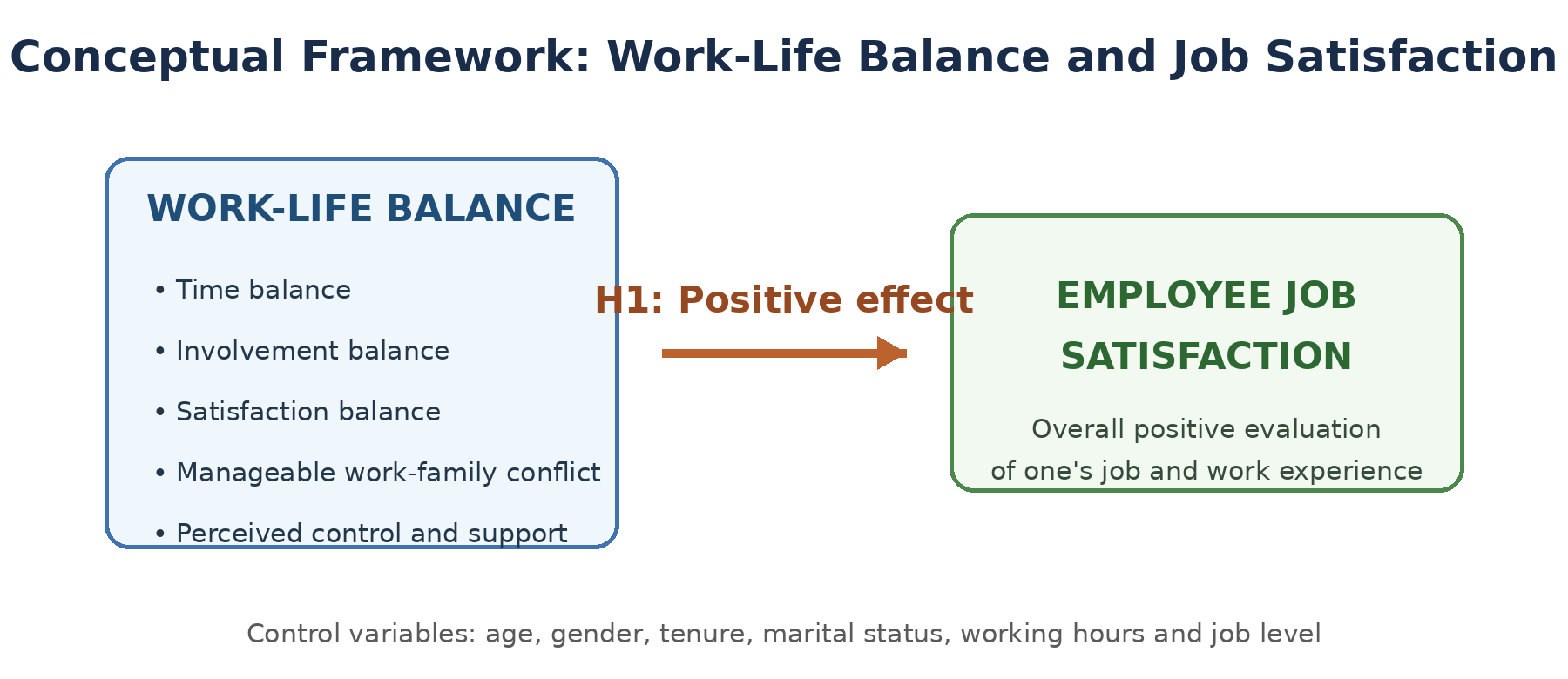
Work-life balance (WLB) has become an important human resource concern because employees increasingly manage simultaneous occupational, family, and personal responsibilities. This methodology paper develops a structured empirical approach for examining whether employees who experience better work-life balance report higher job satisfaction. The proposed study adopts a quantitative, cross-sectional survey design. Work-life balance is measured through a concise multi-item scale informed by established work-family research, while job satisfaction is assessed as employees’ overall positive evaluation of their jobs. A stratified or convenience sample of approximately 200-250 employees from service and administrative organizations is proposed. Data analysis proceeds through reliability assessment, descriptive statistics, Pearson correlation, and multiple regression with demographic controls. For methodological demonstration only, a synthetic dataset is used in the Results section; it shows the expected positive relationship between WLB and job satisfaction but is not presented as real field evidence. The paper integrates research published no later than and provides a transparent sequence for questionnaire design, sampling, data collection, ethical practice, and statistical testing. The proposed framework can support later field studies seeking practical evidence for flexible scheduling, supervisor support, manageable workloads, and boundary-management initiatives
Downloads
Downloads
Published
How to Cite
Issue
Section
License

This work is licensed under a Creative Commons Attribution-NoDerivatives 4.0 International License.
