
A Study of Recruitment and Selection Practices and Their Impact on Employee Performance
DOI:
https://doi.org/10.65521/ijrdmr.v7i1.4287Keywords:
Abstract
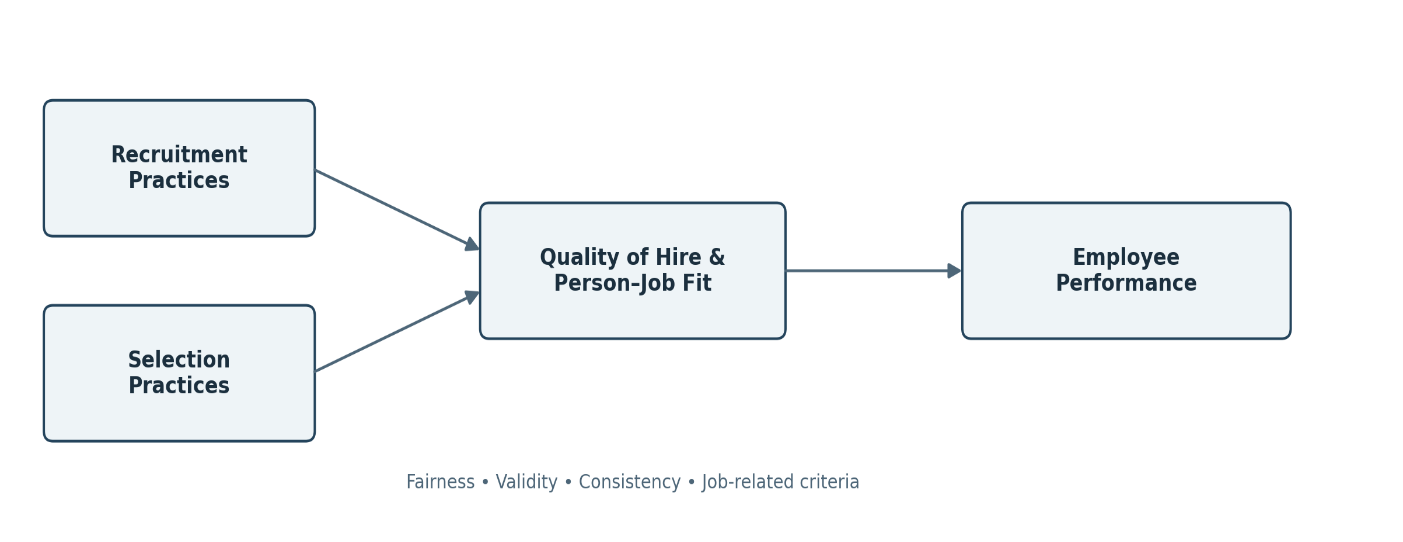
Recruitment and selection determine the quality of human capital entering an organization and therefore influence later productivity, service quality, retention, and employee performance. This methodology paper develops a structured approach for examining the relationship between recruitment practices, selection practices, and employee performance. The proposed study adopts a quantitative, cross-sectional explanatory design using a structured questionnaire administered to employees in medium- and large-sized organizations. Recruitment practices are operationalized through vacancy communication, source effectiveness, realistic job information, transparency, and applicant attraction, while selection practices cover job-related criteria, structured interviews, employment tests, consistency, fairness, and person-job fit. Employee performance is assessed through task quality, target achievement, timeliness, dependability, and work effectiveness. Reliability analysis, descriptive statistics, Pearson correlation, and multiple regression are specified for data analysis. The framework is grounded in established staffing and human-resource-management research published no later than 2015. An illustrative worked analysis shows how transparent recruitment and valid, structured selection can jointly explain meaningful variation in employee performance. The paper concludes that organizations should treat recruitment and selection as an integrated strategic staffing system rather than as isolated administrative activities.
Downloads
Downloads
Published
How to Cite
Issue
Section
License

This work is licensed under a Creative Commons Attribution-NoDerivatives 4.0 International License.
