
The Role of Training and Development in Improving Employee Productivity
DOI:
https://doi.org/10.65521/ijrdmr.v7i1.4284Keywords:
Abstract
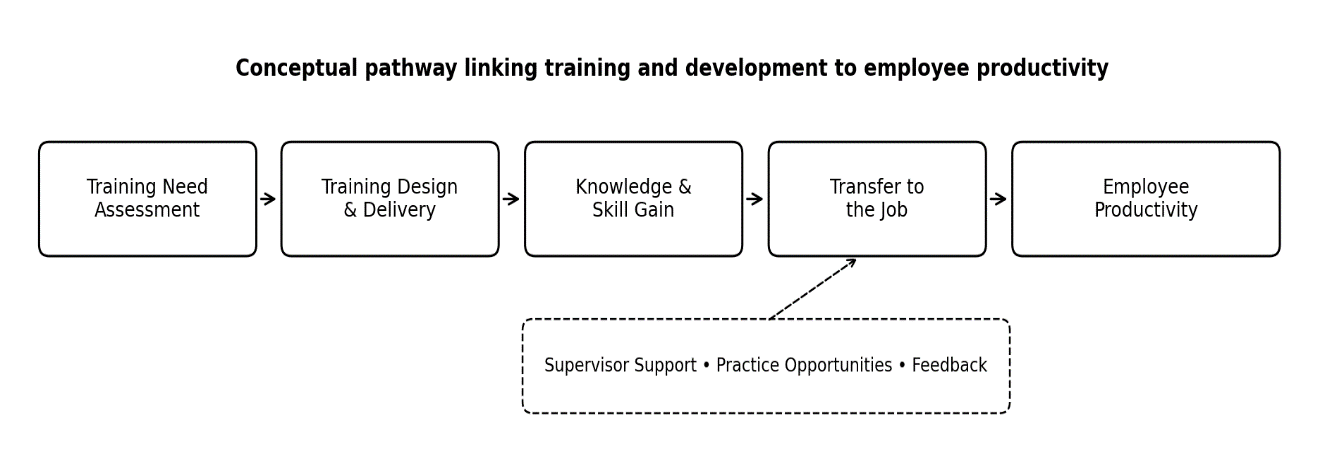
Training and development are central mechanisms through which organizations build employee knowledge, skills, adaptability, and work capability. This methodology paper develops an empirical framework for examining how structured training and continuous employee development influence productivity at the individual level. The study proposes a quantitative, explanatory cross-sectional design in which training quality, development opportunity, learning transfer, and employee productivity are measured through a structured questionnaire. The framework is grounded in evidence showing that training can improve learning and behavioral outcomes, that transfer to the job depends on motivation and organizational support, and that firm-level training is associated with measurable productivity. The proposed procedure includes training-needs assessment, instrument development, pilot testing, probability-based employee sampling, reliability and validity checks, correlation analysis, and multiple regression. Because no primary dataset was supplied for this paper, the Results section presents literature-grounded expected relationships and an explicitly illustrative reporting format rather than fabricated observations. The methodology provides a practical model for evaluating whether training investments translate into improved speed, quality, output consistency, and efficient use of work resources.
Downloads
Downloads
Published
How to Cite
Issue
Section
License

This work is licensed under a Creative Commons Attribution-NoDerivatives 4.0 International License.
