
Platform-Specific Social Media Marketing Strategies and Consumer Engagement: A Comparative Study of Instagram and Facebook
DOI:
https://doi.org/10.65521/ijrdmr.v15i1.1720Keywords:
Social Media Marketing, Consumer Engagement, Instagram, Facebook, Platform-Specific Strategies, TrustAbstract
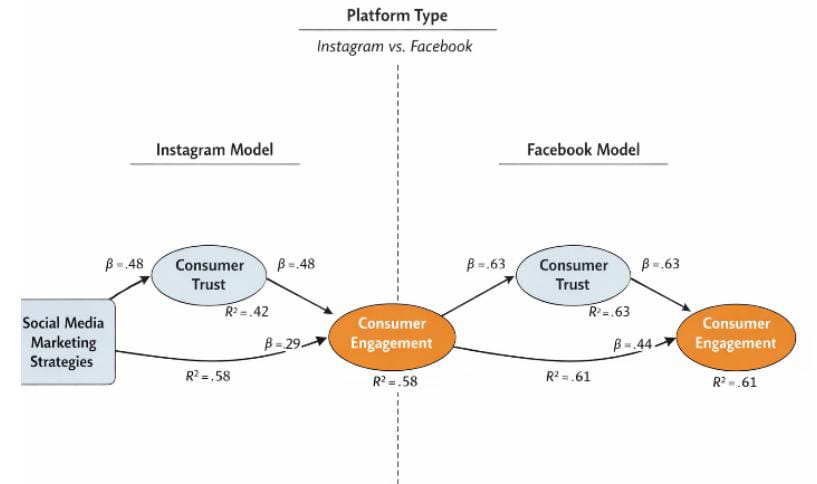
Social media platforms have evolved into distinct marketing ecosystems, yet they are often treated as homogeneous channels in engagement research. This study examines how platform-specific social media marketing strategies (SMMS) influence consumer engagement (CE), with consumer trust (CT) as a mediating mechanism, through a comparative analysis of Instagram and Facebook. Grounded in the Stimulus–Organism–Response (S-O-R) framework, the study conceptualizes SMMS as the stimulus, trust as the organism, and engagement as the behavioral response. Survey data were collected from 300 active users of both platforms and analyzed using Structural Equation Modeling (SEM) and multi-group analysis. Results indicate that SMMS significantly enhance consumer engagement on both platforms; however, structural pathways differ. Instagram engagement is predominantly stimulus-driven and visually responsive, whereas Facebook engagement is more cognitively processed and strongly mediated by trust formation. The findings demonstrate that platform type moderates the relationship between marketing strategies, trust, and engagement. The study contributes to social media marketing literature by highlighting platform-contingent engagement mechanisms and offers strategic guidance for designing differentiated, platform-specific marketing approaches.
Downloads
Downloads
Published
How to Cite
Issue
Section
License

This work is licensed under a Creative Commons Attribution-NoDerivatives 4.0 International License.