Design and Performance Evaluation of an Autonomous Mobile Robot for Warehouse Automation
Keywords:
Abstract
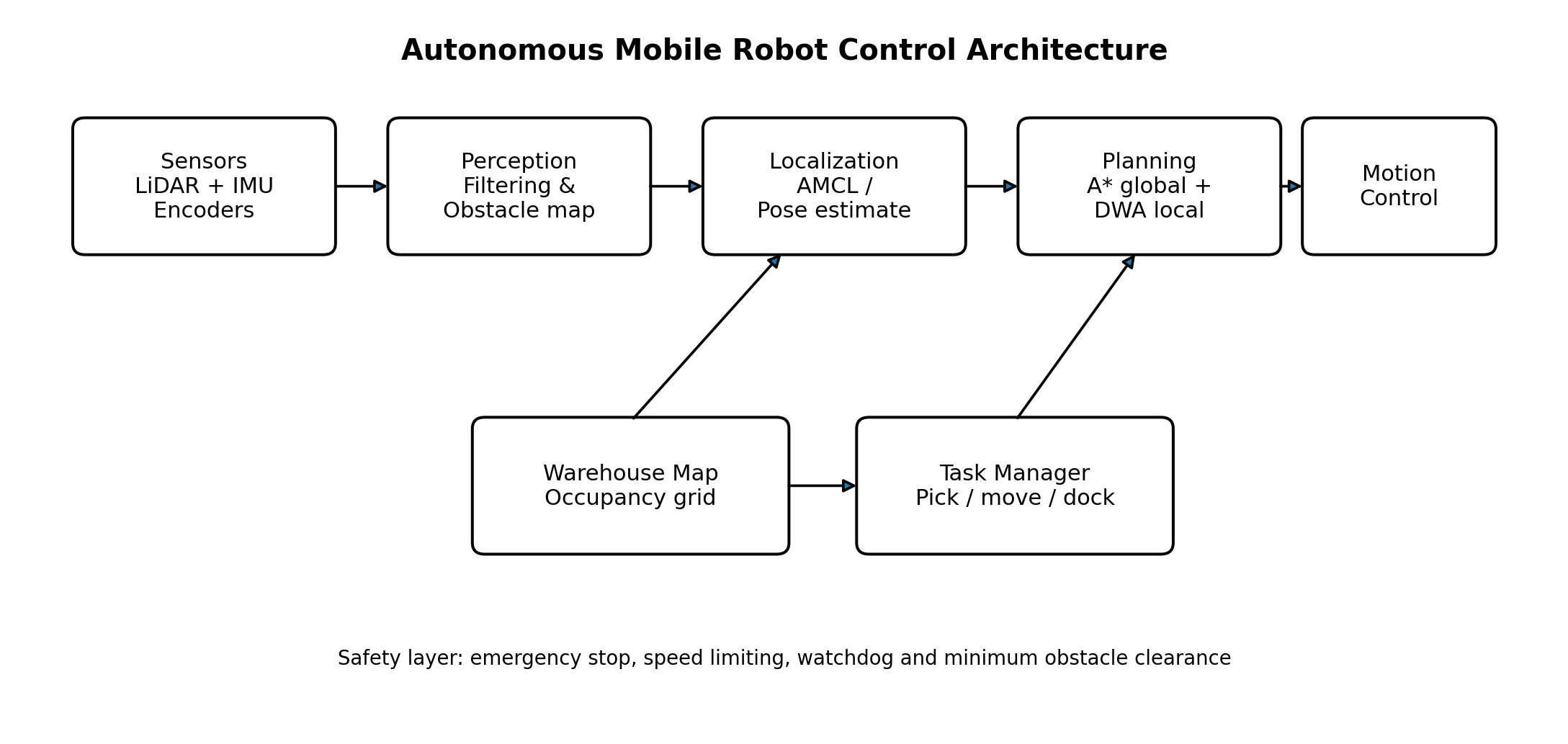
Warehouse automation increasingly requires mobile systems that can operate safely in changing layouts rather than follow fixed guide paths. This paper presents the design and simulation-based performance evaluation of a differential-drive autonomous mobile robot (AMR) for pallet-light and tote transport in indoor warehouses. The proposed architecture integrates two-dimensional LiDAR, wheel encoders and an inertial measurement unit with occupancy-grid mapping, Adaptive Monte Carlo Localization, A* global path planning, and a Dynamic Window Approach local planner. A safety supervisor limits velocity near obstacles and triggers emergency stops when clearance falls below a defined threshold. The methodology evaluates the robot in three warehouse conditions: static aisles, mixed human/robot traffic, and dense dynamic traffic. Sixty seeded missions were executed in a reproducible 2-D test environment and were assessed using path length, mission time, localization error, success rate, and collision rate. The proposed AMR completed 100%, 95%, and 90% of missions in the three scenarios, respectively, while maintaining mean localization error below 0.10 m. Compared with a scripted fixed-route AGV baseline, the AMR reduced mean mission time by approximately 26-31% under dynamic conditions. The study demonstrates that combining probabilistic localization with layered global-local planning provides a practical methodology for flexible warehouse automation, while also identifying the need for hardware validation, fleet-level coordination, and standardized safety testing before industrial deployment.