Optimization of 3D Printing Parameters for Enhanced Mechanical Properties of PLA Components
Keywords:
Abstract
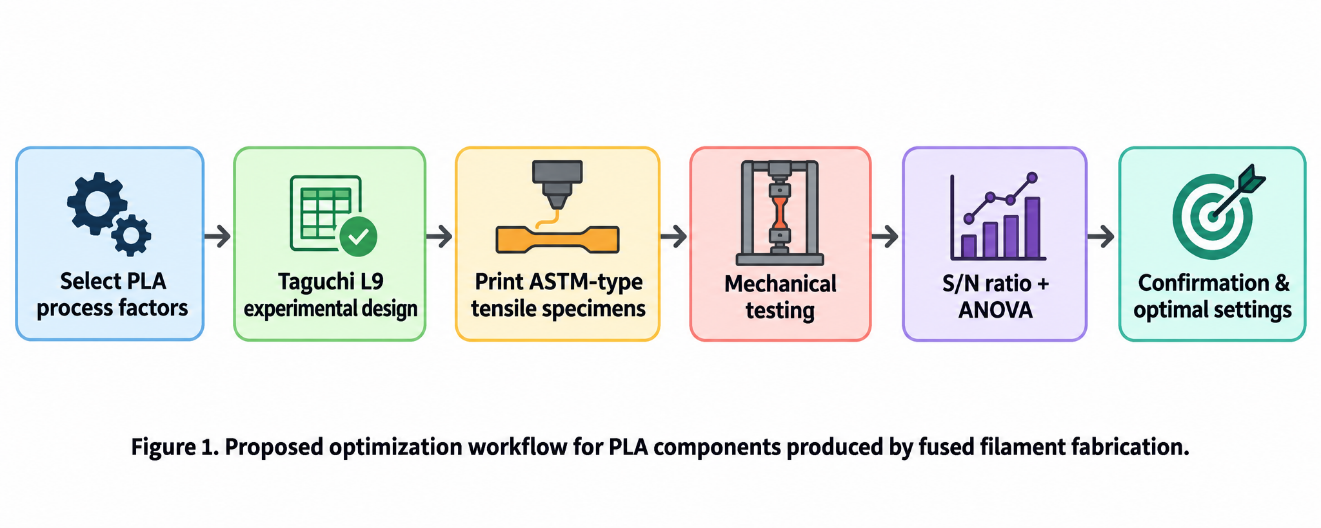
Fused filament fabrication (FFF), commonly referred to as fused deposition modeling, is widely used to manufacture polylactic acid (PLA) components because of its low cost, geometric flexibility, and ease of processing. However, the mechanical performance of printed PLA remains highly dependent on the interaction of printing parameters, and non-optimal settings can produce weak interlayer bonding, internal voids, premature fracture, and inconsistent part quality. This methodology paper develops a systematic parameter-optimization framework for improving the tensile and flexural performance of PLA components. The proposed approach combines a Taguchi L9 design of experiments with signal-to-noise analysis, analysis of variance (ANOVA), regression-based interpretation, and a confirmation run. Four primary factors are considered: layer thickness, infill density, raster orientation, and nozzle temperature, while printing speed, bed temperature, filament diameter, cooling, and specimen geometry are controlled. Mechanical responses are evaluated using ultimate tensile strength, tensile modulus, elongation at break, and flexural strength. Published investigations up to 2023 show that orientation, infill density, layer thickness, and extrusion temperature can substantially change PLA strength by altering road-to-road fusion, void fraction, and load-transfer direction. The framework therefore prioritizes settings that increase effective bonding while avoiding excessive thermal degradation or unnecessarily long build time. The resulting procedure is intended as a reproducible methodology for laboratory optimization of PLA printing conditions and for subsequent validation on functional components.