Finite Element Analysis of Automotive Leaf Springs Using Composite Materials
Keywords:
Abstract
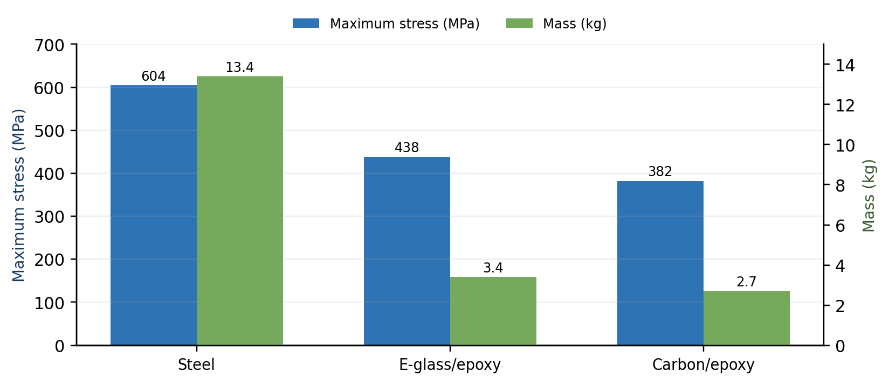
This paper presents a reproducible finite element methodology for replacing a conventional steel semi-elliptic automotive leaf spring with unidirectional E-glass/epoxy and carbon/epoxy mono-leaf alternatives. A common stiffness target is imposed so that material comparisons are not biased by geometry. The workflow combines analytical sizing, three-dimensional static structural analysis, mesh convergence, laminate failure assessment using the Tsai–Wu criterion, modal analysis, and sensitivity checks for fibre orientation and thickness. A representative light-vehicle spring is subjected to a design load of 4.67 kN and a full-bump load of 9.34 kN. The calculated comparison indicates mass reductions of 74.6% for E-glass/epoxy and 79.9% for carbon/epoxy relative to steel, while maintaining a deflection within ±4% of the steel baseline. Peak stress and first natural frequency also improve for the composite designs. The results are numerical estimates for the stated model and require coupon, static, and fatigue testing before production use. The methodology provides a traceable basis for material screening and geometry optimization of lightweight suspension springs.