Design and Fabrication of an Automated Material Handling System Using Pneumatic Actuators
Keywords:
Abstract
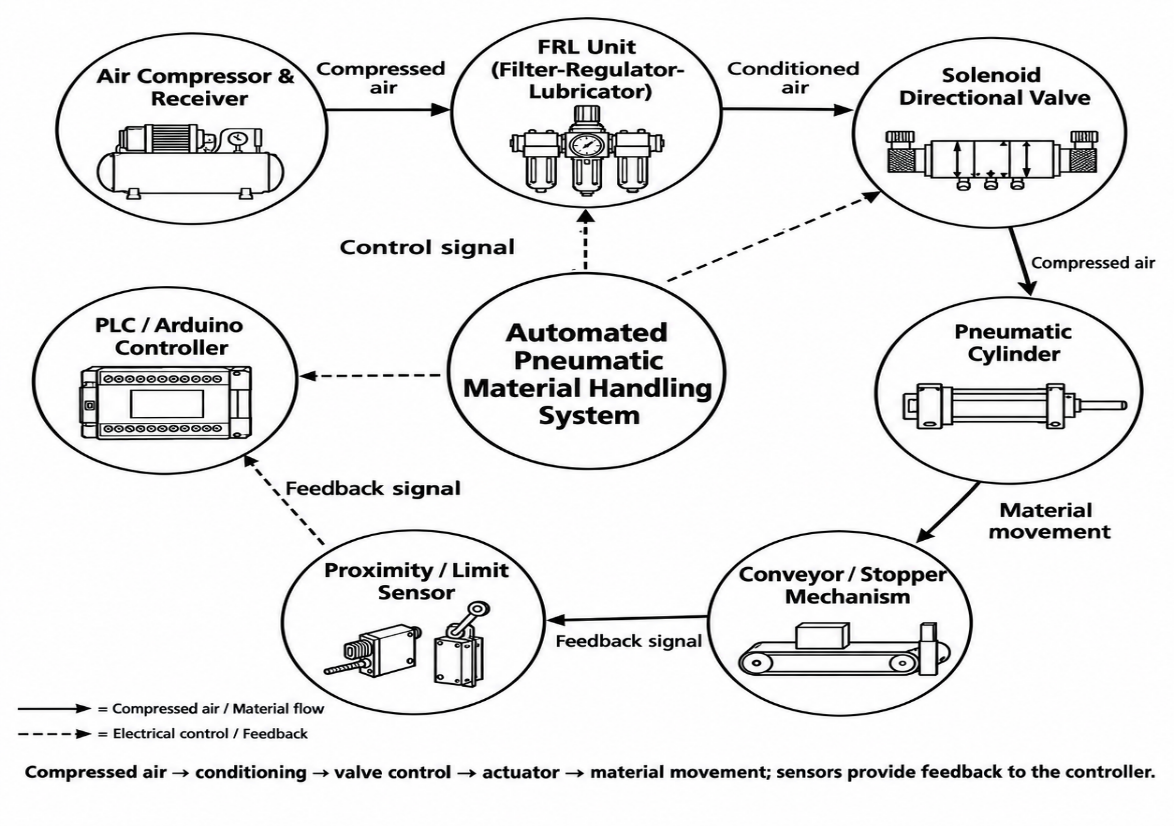
Automated material handling is an important part of modern manufacturing because repetitive transfer, positioning, stopping, and sorting operations can be performed with improved consistency and reduced manual effort. This paper presents a methodology for the design and fabrication of a compact automated material handling system based on pneumatic actuators, a conveyor mechanism, sensors, an air preparation unit, directional control valves, and a programmable controller. The proposed system uses sensor-based detection to initiate a pneumatic actuation sequence in which a cylinder stops, positions, or diverts a workpiece and then retracts to permit the next material to pass. The design procedure covers functional decomposition, actuator sizing, pneumatic circuit selection, frame and conveyor fabrication, electrical control integration, assembly, and performance verification. A design example using a 32 mm bore cylinder at 4 bar is included to demonstrate the force-sizing procedure. The methodology is intended for low-cost laboratory and small-scale industrial material-handling applications where repeatable motion, simple maintenance, and flexible automation are required. Previous research has identified pneumatic actuation as a useful low-cost automation technology, while also noting the nonlinear behavior associated with air compressibility and friction [1–4].