Additive Manufacturing Techniques for Rapid Prototyping of Mechanical Components
Keywords:
Abstract
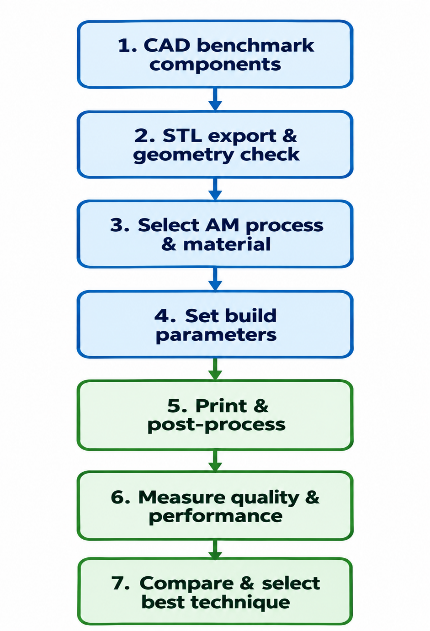
Additive manufacturing (AM) has become a central rapid-prototyping route for mechanical components because it converts a digital model directly into a physical part without dedicated tooling. This methodology paper establishes a structured framework for comparing four widely used AM routes—fused deposition modelling/fused filament fabrication (FDM/FFF), stereolithography (SLA), selective laser sintering (SLS), and metal powder-bed fusion represented by selective laser melting/direct metal laser sintering (SLM/DMLS). The proposed method uses common CAD benchmark components, controlled file preparation, process-specific but comparable build settings, standardized dimensional and surface measurements, and a decision matrix based on accuracy, build time, material capability, post-processing demand, cost, and functional performance. Published research up to 2020 is used to define process behaviour and realistic comparative trends. The synthesis indicates that FDM is the most economical and accessible route for form-and-fit prototypes, SLA provides the highest visual detail and surface quality for polymer models, SLS is advantageous for support-free functional polymer components, and SLM/DMLS is preferred when the prototype must reproduce metallic strength and end-use behaviour. The proposed methodology helps mechanical designers select a prototyping process according to the functional purpose of a component rather than relying on a single performance criterion.