Design and Analysis of a Robotic Arm for Automated Material Handling Operations
Keywords:
Abstract
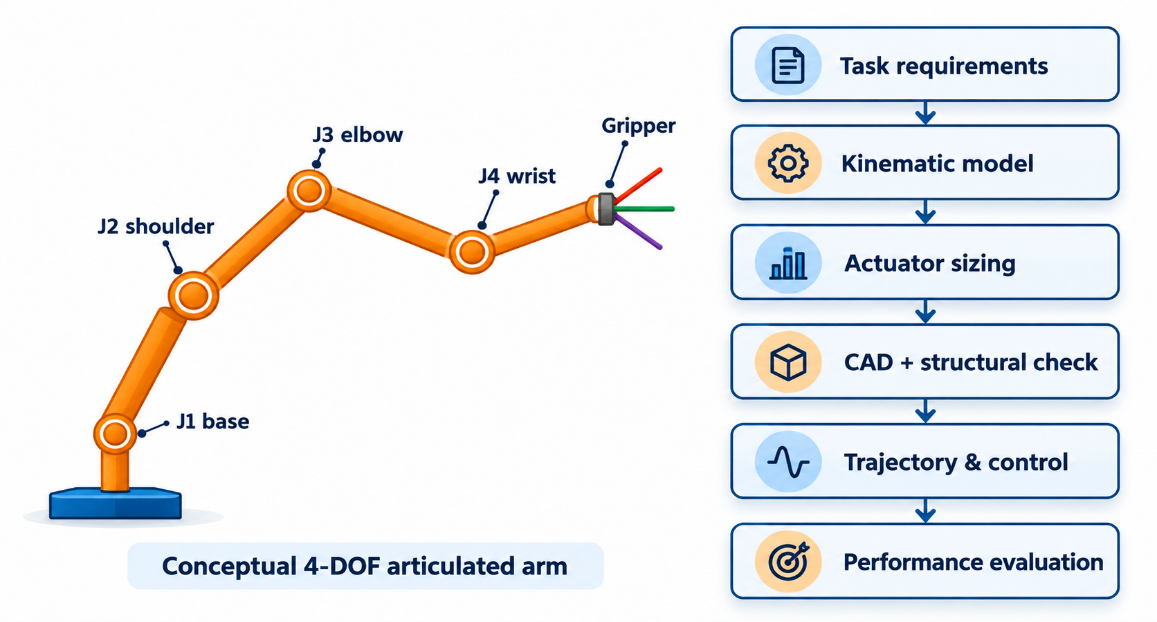
This paper presents a compact design-and-analysis methodology for an articulated robotic arm intended for automated material handling, particularly repetitive pick-and-place transfer between trays, conveyors, fixtures, and pallets. The proposed concept uses four revolute degrees of freedom with a two-finger gripper, a nominal 650 mm reach, and a 2 kg payload. The methodology integrates task definition, Denavit-Hartenberg kinematic modelling, workspace verification, static and dynamic torque estimation, actuator selection, computer-aided mechanical design, structural checking, trajectory generation, and controller-level validation. The most highly loaded configuration occurs when the shoulder and elbow links are approximately horizontal; under the assumed masses and a dynamic load factor of 1.30, the required shoulder output torque is 28.9 N·m and the elbow torque is 12.8 N·m. A representative structural model of the aluminium-link/joint assembly gives a maximum equivalent stress of 64 MPa, a tip deflection of 0.82 mm, and a factor of safety above four relatives to 6061-T6 yield strength. Joint-space cubic trajectories provide smooth transfer with a simulated end-effector path RMSE of 2.6 mm and a 5.8 s pick-and-place cycle. The study demonstrates a repeatable framework for sizing and evaluating robotic arms before prototype fabrication and industrial deployment.