Optimization of Cnc Machining Parameters Using Genetic Algorithm Techniques
Keywords:
Abstract
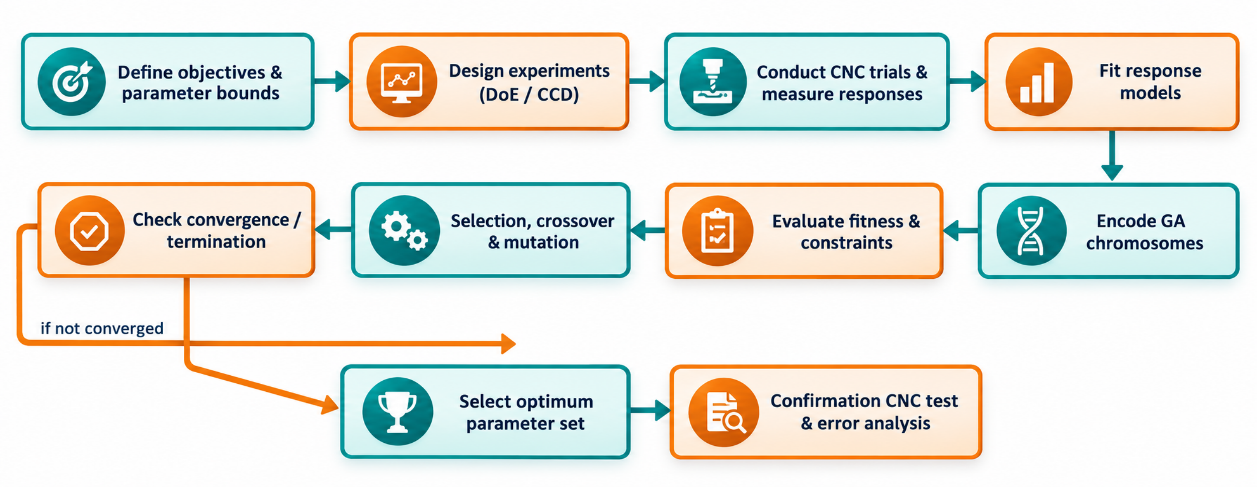
Computer numerical control (CNC) machining performance is strongly influenced by cutting speed or spindle speed, feed rate, and depth of cut. Conventional parameter selection based on handbooks or trial-and-error can give acceptable parts, but it rarely guarantees the best compromise among surface quality, productivity, cutting load, and machining time. This methodology paper presents a structured genetic algorithm (GA) framework for optimizing CNC machining parameters. The proposed workflow combines design of experiments, response modeling, constraint handling, and real-coded evolutionary search. Surface roughness (Ra) is treated as the primary quality response, while material removal rate (MRR) and cutting force are used to represent productivity and process loading. The GA searches the bounded machining domain using selection, crossover, mutation, elitism, and penalty functions for quality constraints. A reproducible numerical demonstration is included to show how the method can identify a high-productivity parameter combination while maintaining specified limits on Ra and cutting force. The demonstration improves MRR from 900 to approximately 1228 mm³/min while satisfying Ra ≤ 1.40 µm and cutting force ≤ 240 N. The framework is compatible with CNC turning, milling, micro-milling, and other machining processes and can be extended to multi-objective Pareto optimization. The paper emphasizes experimental confirmation of GA-recommended settings before industrial adoption.