CFD Analysis of Airflow Characteristics in Automotive Aerodynamic Systems
Keywords:
Abstract
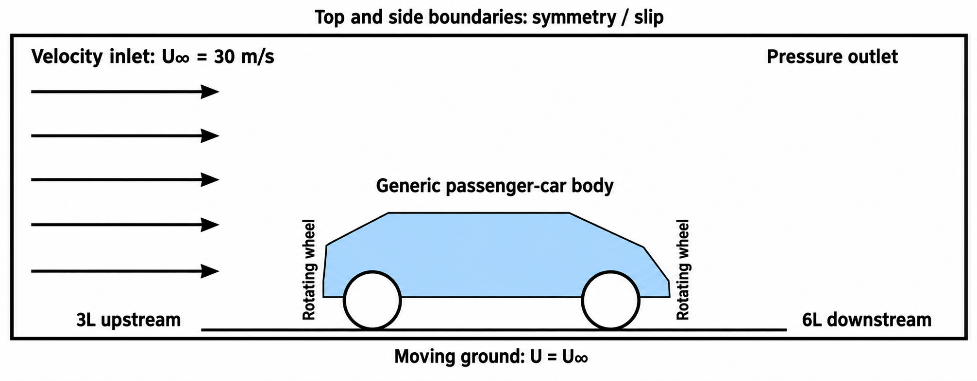
Computational fluid dynamics (CFD) has become a central tool for evaluating external vehicle aerodynamics because it resolves velocity, pressure, wall shear and wake structures that are difficult to obtain comprehensively from road testing alone. This methodology paper presents a reproducible CFD framework for analysing airflow characteristics around a generic passenger-car aerodynamic system, with emphasis on front stagnation, roof acceleration, underbody flow, wheel interactions, rear separation and wake formation. A three-dimensional incompressible Reynolds-averaged Navier-Stokes formulation is proposed with the shear-stress-transport (SST) k-omega turbulence model. The method uses a full-vehicle computational domain, moving ground, rotating wheels, near-wall prism layers and local refinement in separation and wake regions. Grid independence is evaluated using three mesh densities, while convergence is assessed from residuals and stabilized drag and lift coefficients. The post-processing plan includes velocity ratio, surface pressure coefficient, streamlines, recirculation length, drag coefficient and lift coefficient. For methodological illustration, a representative baseline case at 30 m/s is reported: the medium mesh gives a drag coefficient of 0.308, while refinement to 6.5 million cells changes drag by less than 1%. The flow field shows accelerated roof and underbody streams and a low-momentum recirculating wake behind the rear surface. These numerical values are demonstration results for the defined workflow rather than substitute measurements from a completed wind-tunnel campaign. The proposed procedure combines the benchmark lessons of Ahmed-body studies with more realistic DrivAer-oriented practice and provides a compact framework suitable for academic vehicle-aerodynamics investigations.