Design and Fabrication of an Autonomous Obstacle Avoidance Robot Using Ultrasonic Sensors
Keywords:
Abstract
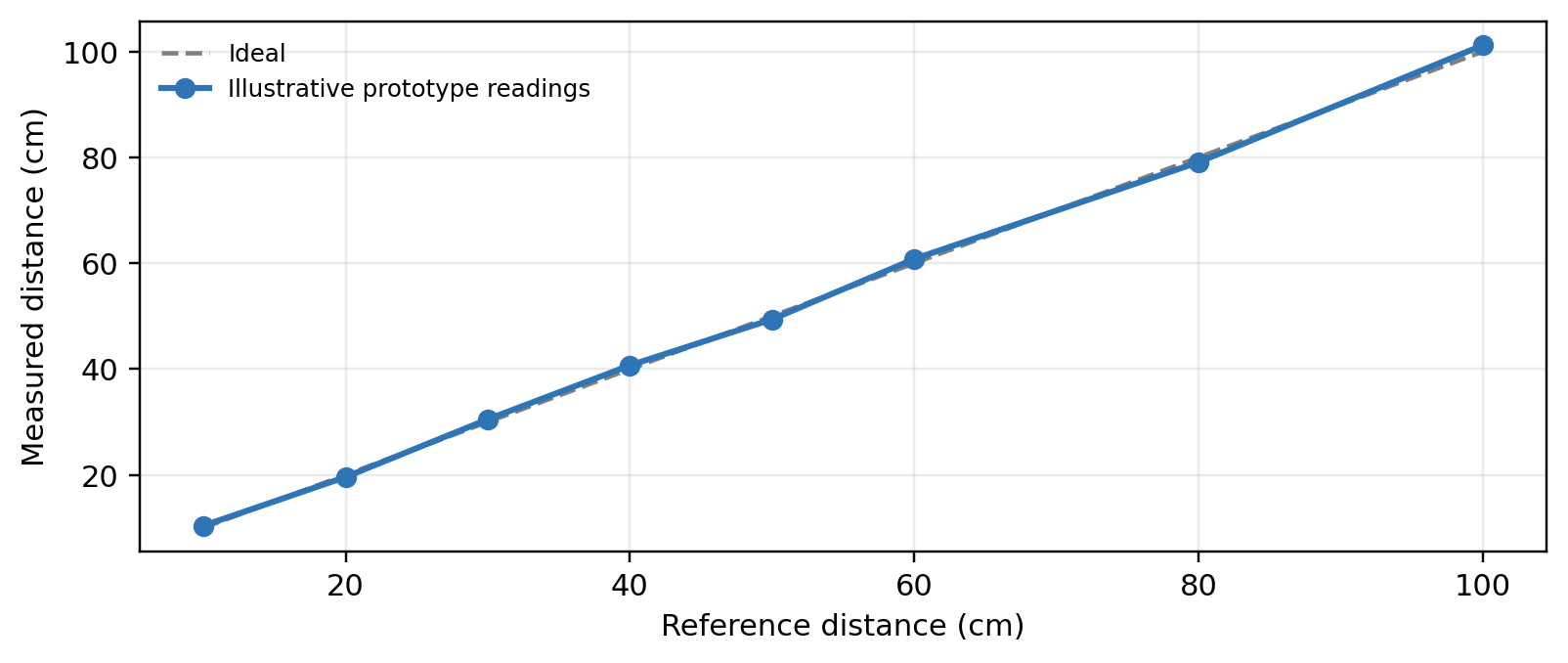
This paper presents a reproducible methodology for designing and fabricating a low-cost autonomous differential-drive robot that detects and avoids obstacles using ultrasonic time-of-flight ranging. The proposed platform combines an Arduino Uno, an HC-SR04 ultrasonic module mounted on a micro-servo, an L298N dual H-bridge, geared DC motors, and a two-wheel chassis. The controller repeatedly measures the forward clearance, filters invalid echoes, compares the estimate with a 25 cm safety threshold, and commands forward motion, braking, reverse clearance, or a left/right pivot selected from scanned side distances. Mechanical layout, power distribution, embedded logic, calibration, and a controlled test protocol are specified step by step. An illustrative prototype dataset demonstrates mean absolute distance error of 0.69 cm across 10–100 cm and 27 successful avoidance trials out of 30 (90%). These values are supplied as a worked reporting example and must be replaced or confirmed by independently recorded measurements before submission as empirical evidence. The method emphasizes affordability, modular construction, and transparent validation while acknowledging acoustic blind zones, specular reflection, cross-talk, and the absence of global path planning.