Development of An Autonomous Line Following Robot Using Embedded Control Techniques
Keywords:
Abstract
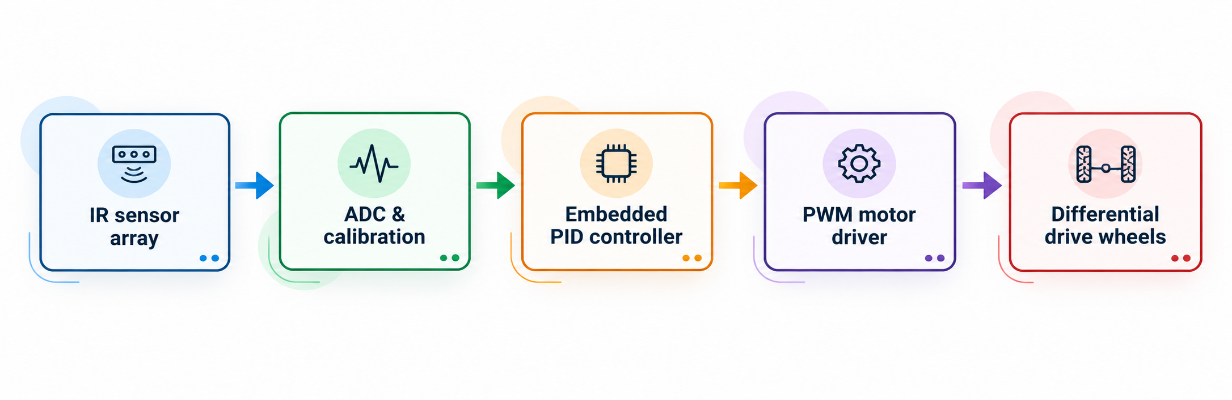
This paper presents a reproducible methodology for developing an autonomous line-following robot based on an embedded microcontroller, a five-element infrared reflectance array, pulse-width-modulated motor actuation, and discrete proportional-integral-derivative (PID) steering. The method converts calibrated sensor intensities into a normalized lateral-error estimate, filters short disturbances, and maps the control effort into differential wheel-speed commands. Hardware selection, mechanical integration, firmware scheduling, gain tuning, and track-based validation are described as sequential stages. A representative prototype-validation dataset is supplied to demonstrate the analysis procedure: compared with threshold-based steering, PID control reduced mean absolute lateral error from 18.6 mm to 7.4 mm, decreased lap time from 28.9 s to 24.7 s, and completed 19 of 20 laps without line loss. The approach emphasizes inexpensive components, deterministic sampling, saturation handling, and repeatable performance metrics. It is suitable for undergraduate robotics laboratories and for small guided material-transport demonstrators, while retaining a clear path toward encoder feedback, adaptive speed scheduling, and more robust perception.