
Experimental Investigation and Performance Evaluation of a Solar-Powered Forced-Convection Leafy Vegetable Dehydrator
DOI:
https://doi.org/10.65521/ijmer.v11i1.3923Keywords:
Abstract
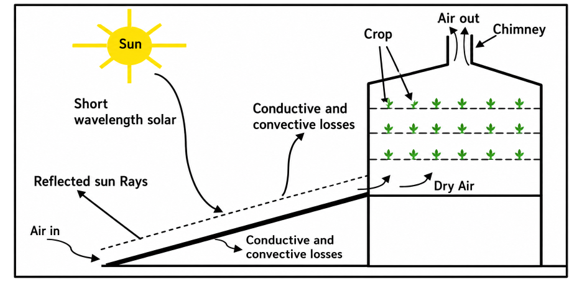
Post-harvest losses of agricultural perishables, particularly leafy green vegetables, pose severe economic and nutritional challenges in developing regions due to inefficient preservation techniques and unreliable grid power. Open sun drying and traditional shadow drying suffer from prolonged drying times, insect infestation, airborne contamination, and loss of nutritional or sensory quality. This study presents the development, fabrication, and experimental validation of an off-grid, low-cost, forced-convection indirect solar dehydrator optimized for leafy green vegetables. The system incorporates a flat-plate solar thermal collector integrated with an insulated wooden drying chamber, an automated forced air distribution unit powered by a direct current (DC) axial fan, and a dedicated photovoltaic (PV) panel. Comparative experimental evaluations were conducted across three drying operational modes—Open Sun Drying (OSD), Shadow Drying (under fan airflow), and Solar Dehydrator Drying—utilizing equal 100 g samples of spinach (Spinacia oleracea), coriander (Coriandrum sativum), and fenugreek (Trigonella foenum-graecum). Results indicate that the indirect solar dehydrator reduced moisture content to 0% within 11 hours for spinach, 9 hours for coriander, and 9 hours for fenugreek, achieving maximum drying rates of 0.92, 0.85, and 0.88, respectively. In comparison, traditional sun and shadow drying required multiple days while yielding inferior color, aroma, and structural integrity. Total fabrication cost was evaluated at ₹14,400. The developed indirect solar dehydrator proves to be an efficient, affordable, and sustainable technology for small-scale rural and domestic food preservation applications.
Downloads
Published
How to Cite
Issue
Section
License

This work is licensed under a Creative Commons Attribution-NoDerivatives 4.0 International License.
