Comparative Study of Deep Learning Techniques for Automatic Face Recognition
DOI:
https://doi.org/10.65521/ijeecs.v10i1.4538Keywords:
Abstract
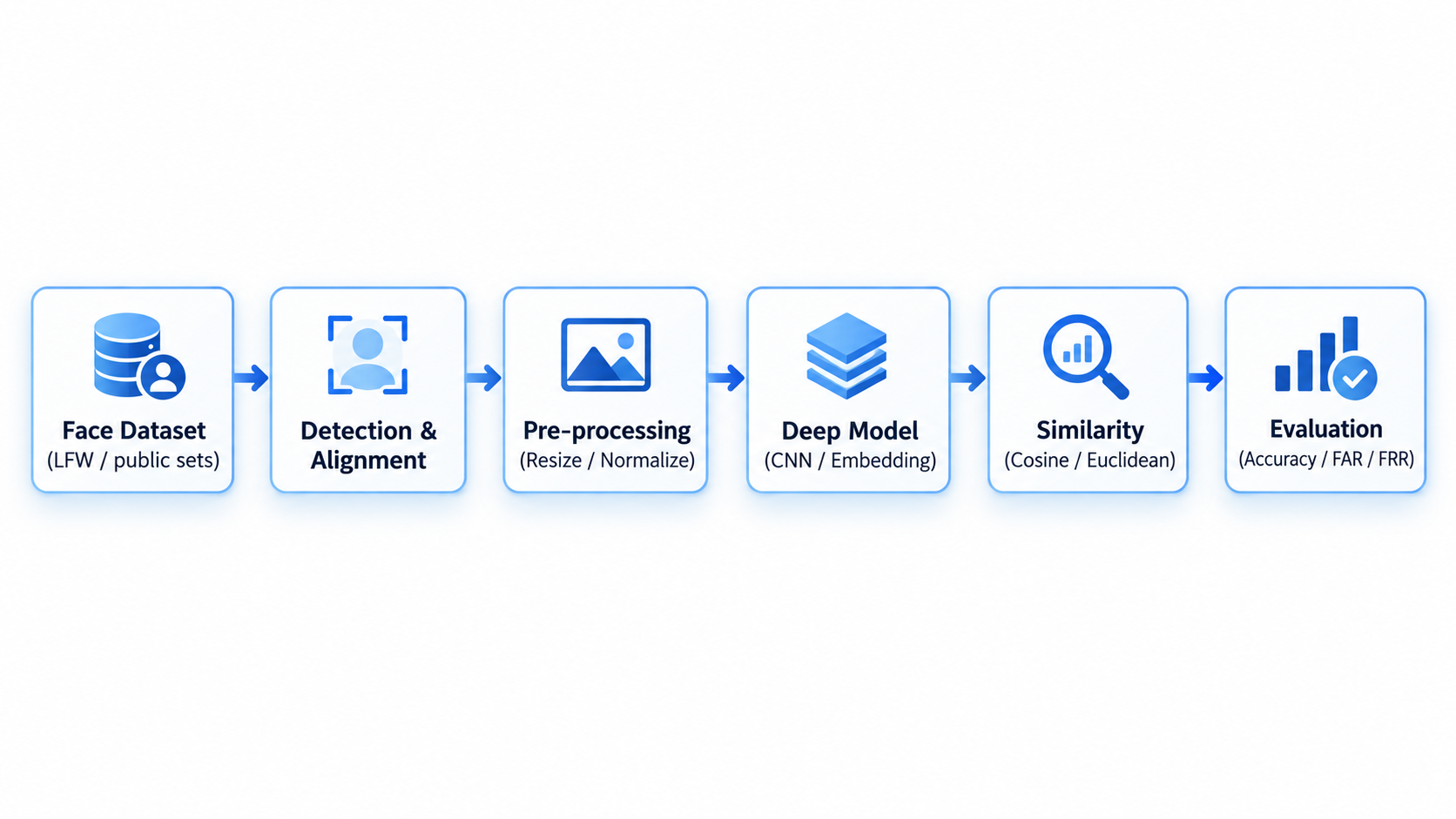
Automatic face recognition has shifted from handcrafted descriptors to deep representation learning, where convolutional neural networks learn identity-discriminative embeddings directly from facial images. This methodology paper compares major deep-learning approaches that shaped face recognition up to 2021, with emphasis on DeepFace, FaceNet, SphereFace, CosFace, and ArcFace. The comparison is organized around network representation, loss function, embedding geometry, matching strategy, reported benchmark performance, and practical robustness. A structured evaluation pipeline is proposed using face detection, alignment, normalization, embedding extraction, similarity scoring, and verification/identification metrics. Published results on Labeled Faces in the Wild (LFW) are synthesized to illustrate the historical improvement from conventional softmax-based deep models to metric-learning and angular-margin objectives. The comparison indicates that the main methodological advance is not merely greater depth, but the explicit optimization of intra-class compactness and inter-class separation in the embedding space. Remaining challenges include pose, age, occlusion, demographic imbalance, presentation attacks, privacy, and generalization to unconstrained operational conditions.