Development of a Wireless Sensor Network for Environmental Monitoring Applications
DOI:
https://doi.org/10.65521/ijeecs.v4i1.4481Keywords:
Abstract
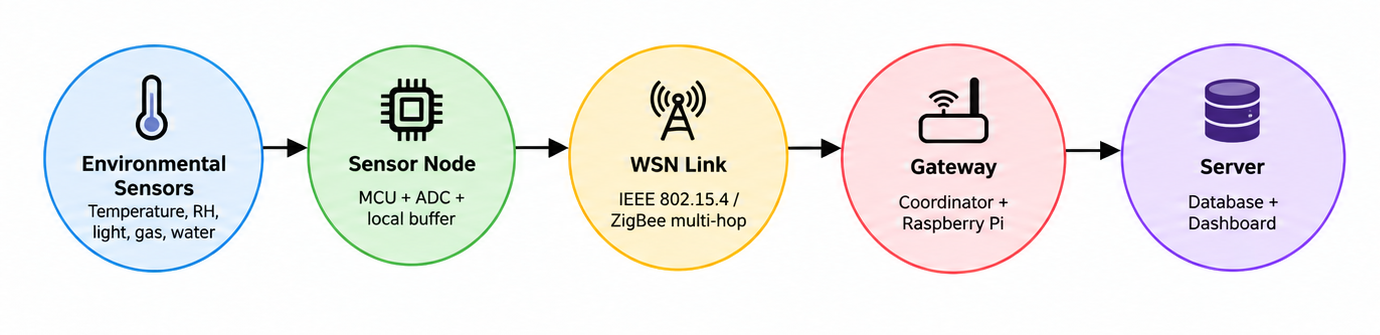
Wireless sensor networks (WSNs) provide a practical approach for acquiring environmental data at spatial and temporal resolutions that are difficult to achieve with conventional manual monitoring. This paper presents a methodology for developing a low-cost WSN for environmental monitoring applications using distributed sensing nodes, IEEE 802.15.4/ZigBee communication, a gateway computer, and a central database. The proposed system is designed to measure representative variables such as air temperature, relative humidity, light intensity, and selected air- or water-quality parameters while minimizing energy consumption and communication overhead. The methodology covers requirement analysis, sensor selection and calibration, node hardware design, multi-hop network formation, packet structure, sampling strategy, gateway integration, data validation, and performance evaluation. A simulation-based validation scenario is also defined to demonstrate how packet delivery ratio, latency, measurement error, and data completeness can be assessed before long-term field deployment. The design is informed by established WSN and environmental sensor-network research published up to 2015. The resulting architecture emphasizes modularity, low cost, scalability, remote data access, and maintenance-aware operation. It is suitable as a reproducible framework for small agricultural plots, urban microclimate studies, water-quality observation, and general environmental monitoring where dense measurements and unattended operation are required.