Normalized Performance Assessment and Loss Evaluation of Grid-Connected Photovoltaic Systems
DOI:
https://doi.org/10.65521/ijeecs.v8i1.4509Keywords:
Abstract
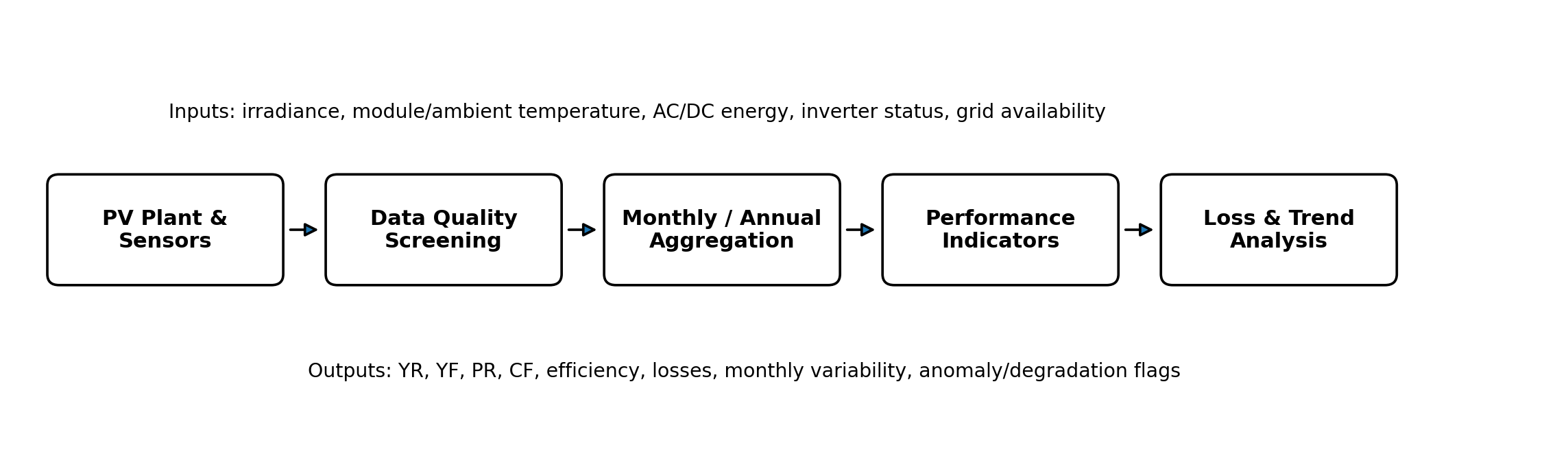
The technical performance of grid-connected photovoltaic systems depends not only on available solar irradiation but also on module temperature, inverter operation, system losses, grid availability, maintenance, and long-term component degradation. This study presents a reproducible methodology for normalized performance assessment and loss evaluation of grid-connected photovoltaic systems using routinely monitored plant and meteorological data. The framework begins with data acquisition and quality screening and then calculates reference yield, final yield, performance ratio, capacity factor, conversion efficiency, and normalized array and system losses. Monthly and annual aggregation is used to identify seasonal variation, while environmental and operational analysis is applied to distinguish irradiation-related effects from temperature, soiling, mismatch, inverter downtime, wiring loss, and grid-interruption impacts. Performance ratio is treated as a central normalized indicator because it allows plant conversion quality to be evaluated with reduced dependence on absolute solar-resource magnitude. The methodology is validated using published benchmark studies covering rooftop, commercial, and utility-scale grid-connected PV installations operating under different climatic conditions and module technologies. The reviewed evidence shows substantial variation in annual performance ratio and specific energy yield across sites, confirming that system performance should be interpreted relative to local climate, technology, plant age, maintenance history, and data quality rather than against a single universal threshold. The proposed framework supports technical diagnosis, operation and maintenance assessment, technology comparison, commissioning review, and long-term degradation monitoring of grid-connected photovoltaic assets.