IoT-Enabled Smart Home Energy Management System with Real-Time Monitoring
DOI:
https://doi.org/10.65521/ijeecs.v11i1.4535Keywords:
Abstract
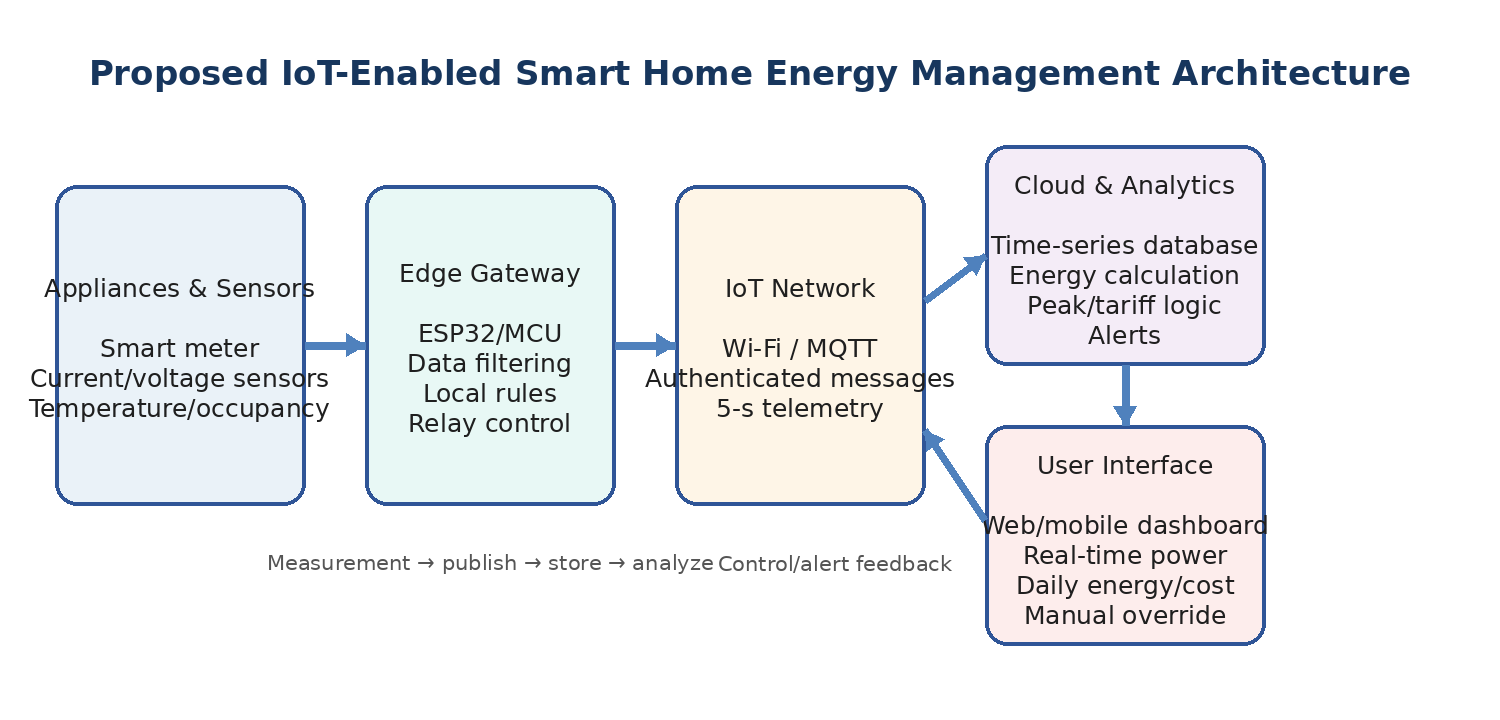
Residential electricity demand is increasingly influenced by connected appliances, variable tariffs, distributed generation, and the need for immediate feedback to occupants. This methodology paper proposes an Internet of Things (IoT)-enabled Smart Home Energy Management System (HEMS) that measures household electrical variables, streams data through a lightweight messaging layer, performs real-time energy and peak-demand analysis, and provides both automated and user-directed appliance control. The proposed design follows a cyber-physical HEMS structure consisting of data acquisition, communication, analytics, and a control interface. Smart plugs or current/voltage sensors feed an ESP32-class edge gateway; MQTT over Wi-Fi transfers time-stamped readings to a cloud time-series database; and a dashboard displays instantaneous power, cumulative energy, estimated cost, and device status. A rule-based demand-side controller delays or disconnects flexible loads when demand exceeds a programmable threshold or when a peak-tariff period is active, while preserving critical loads and allowing manual override. A controlled 24-hour simulation is used to demonstrate the evaluation procedure. Under the stated assumptions, the managed profile reduces total energy use by approximately 16%, peak demand by about 27%, and tariff-weighted energy cost by about 21%, while retaining sub-second local control and near-real-time dashboard visibility. The methodology is intended as a reproducible baseline for laboratory or small-residential validation rather than as a substitute for long-term field trials.