Performance Analysis Of Wireless Sensor Networks for Industrial Monitoring Applications
DOI:
https://doi.org/10.65521/ijeecs.v6i1.4492Keywords:
Abstract
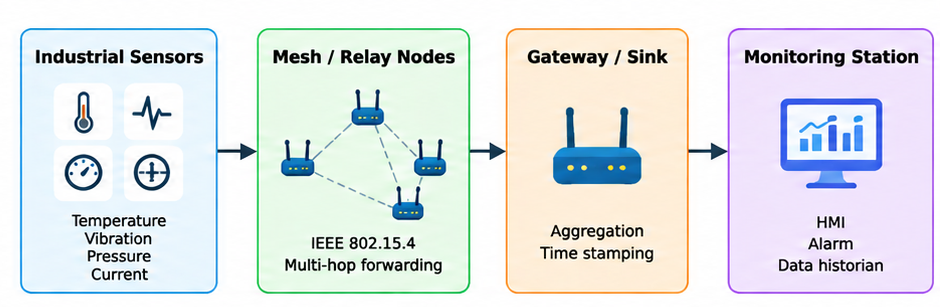
Wireless sensor networks (WSNs) provide a flexible means of collecting temperature, vibration, pressure, current and other condition-monitoring data in industrial plants where cable installation is expensive or impractical. Their performance, however, is strongly affected by radio propagation, metallic obstructions, interference, routing depth and the energy constraints of sensor nodes. This paper presents a methodology for evaluating an industrial WSN using four principal indicators: packet delivery ratio (PDR), end-to-end delay, throughput and energy consumed per generated packet. A 30-node multi-hop monitoring network is modeled in a 2.4 GHz industrial environment, with low, moderate and high interference conditions. The evaluation procedure combines a controlled traffic model, probabilistic per-hop transmission, one retransmission opportunity and energy accounting for transmission, reception, processing and sensing. The resulting simulation shows a progressive degradation as interference increases: PDR declines from approximately 99.2% under low interference to 85.6% under high interference, while average delay and energy expenditure rise. The findings reinforce the industrial design principles reported in pre-2018 literature: dependable monitoring requires robust link margins, channel-aware operation, bounded retransmissions, careful routing and traffic engineering. The paper therefore offers a concise and reproducible framework for comparing WSN configurations before deployment in harsh industrial facilities.