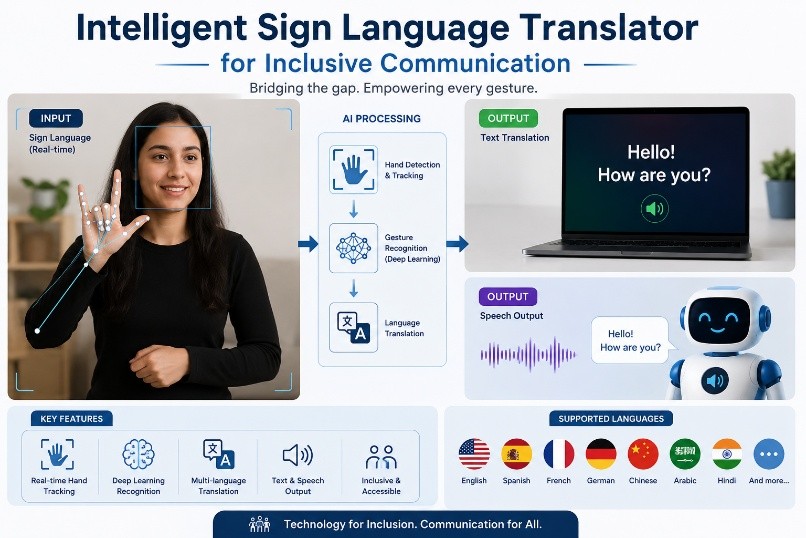
Intelligent Sign Language Translator for Inclusive Communication
DOI:
https://doi.org/10.65521/ijeecs.v15i1S.3036Keywords:
Abstract
Communication is a fundamental human need, yet individuals with hearing and speech impairments often face significant barriers in interacting with others. Sign language serves as a primary mode of communication for the deaf and mute community; however, a lack of widespread understanding among the general population limits effective interaction. This research paper presents an intelligent sign language translator designed to bridge this communication gap and promote inclusivity. The proposed system leverages advancements in computer vision and deep learning techniques to recognize hand gestures and convert them into meaningful text or speech in real time. The system utilizes image processing methods to capture hand gestures through a camera and employs Convolutional Neural Networks (CNN) for accurate gesture classification. A trained model is developed using a labelled dataset of sign language gestures to ensure reliable recognition performance. The translated output is then displayed as text or converted into audio, enabling seamless communication between users. This approach aims to provide a user-friendly, cost-effective, and efficient solution that can be used in everyday scenarios such as education, healthcare, and public services. The system also emphasizes real-time processing and high accuracy to enhance user experience. The proposed solution contributes to breaking communication barriers and supports the vision of an inclusive society where individuals with disabilities can interact freely and independently. Future enhancements may include multilingual support, improved gesture recognition accuracy, and integration with mobile applications for wider accessibility.