A Comparative Study of Routing Protocols in Mobile Ad Hoc Networks
DOI:
https://doi.org/10.65521/ijeecs.v6i1.4491Keywords:
Abstract
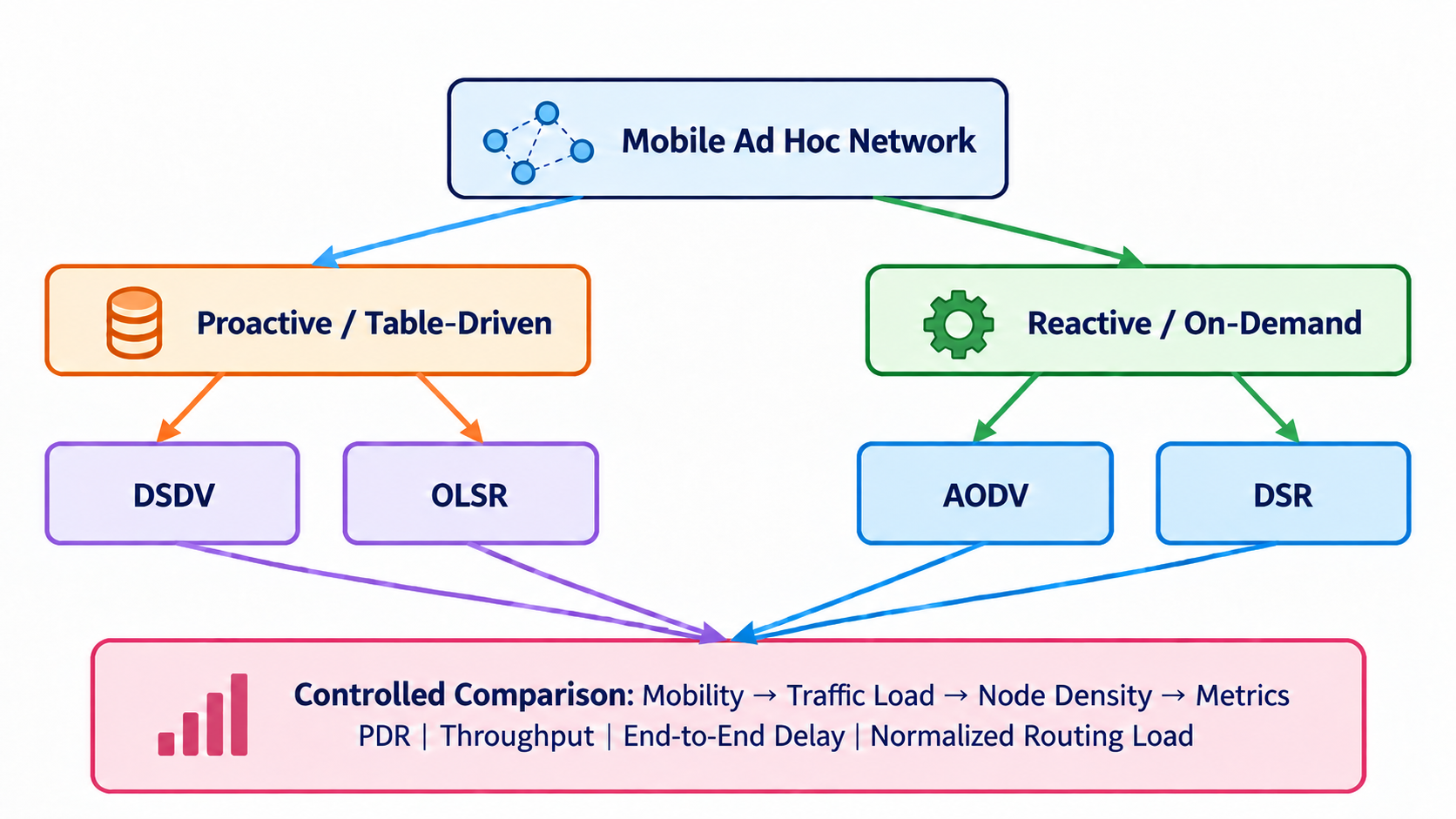
Mobile ad hoc networks (MANETs) rely on distributed routing because mobile nodes communicate without fixed infrastructure and may act simultaneously as end systems and routers. The choice of routing protocol strongly influences delivery reliability, delay, throughput, and control overhead when topology changes. This paper develops a structured methodology for comparing four widely studied MANET routing protocols: Destination-Sequenced Distance-Vector (DSDV), Optimized Link State Routing (OLSR), Ad hoc On-Demand Distance Vector (AODV), and Dynamic Source Routing (DSR). The study combines protocol-level analysis with a reproducible simulation design in which node density, mobility, and traffic load are treated as controlled factors. Packet delivery ratio, average end-to-end delay, throughput, and normalized routing load are used as the primary performance measures. Rather than presenting fabricated packet-trace data, the Results section synthesizes consistent comparative trends reported by established simulation studies published up to 2017. The synthesis indicates that proactive protocols offer immediate route availability but pay periodic control costs, whereas reactive protocols reduce idle routing overhead but introduce route-discovery latency. AODV provides a strong overall balance under moderate-to-high mobility; DSR is efficient in smaller networks but becomes sensitive to cache staleness and source-route header growth; DSDV is predictable at low mobility; and OLSR is attractive in dense, continuously communicating networks. The proposed methodology provides a transparent basis for selecting protocols according to application conditions rather than a single universal ranking.