A Comprehensive Review of Deep Recursive Self-Attention Modules: MANET-Based Integrated Sensor System for Disaster Detection and Communication in Hazardous Environments
DOI:
https://doi.org/10.65521/ijeecs.v14i2.2866Keywords:
Abstract
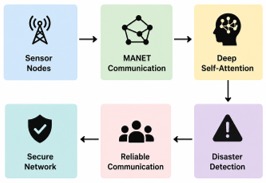
Disaster detection and communication in hazardous environments require robust, decentralized, and intelligent systems capable of operating without fixed infrastructure. Mobile Ad Hoc Networks (MANETs), combined with integrated sensor systems, have emerged as a promising solution for real-time monitoring and emergency communication. This paper presents a comprehensive review of deep recursive self-attention modules integrated with MANET-based sensor networks for disaster detection. The proposed approach leverages deep learning architectures, particularly recursive attention mechanisms, to enhance feature extraction and temporal analysis of sensor data collected from distributed nodes. These models enable efficient identification of disaster events such as chemical spills, earthquakes, and fire outbreaks with high accuracy. The integration of MANET ensures dynamic communication among nodes, enabling reliable data transmission even in infrastructure-less environments. Furthermore, the system supports real-time decision-making through distributed processing and adaptive routing protocols. The review highlights advancements in deep learning-based intrusion detection, clustering techniques, and IoT-MANET integration for healthcare and disaster management. Challenges such as energy efficiency, network stability, security threats, and computational constraints are also discussed. The study concludes that hybrid architectures combining deep recursive attention mechanisms with MANET-based sensor systems provide a scalable, reliable, and intelligent framework for disaster detection and communication in hazardous environments.