A Multi-Parameter IoT Framework for Continuous Physiological Monitoring of Comatose Patients
Keywords:
Abstract
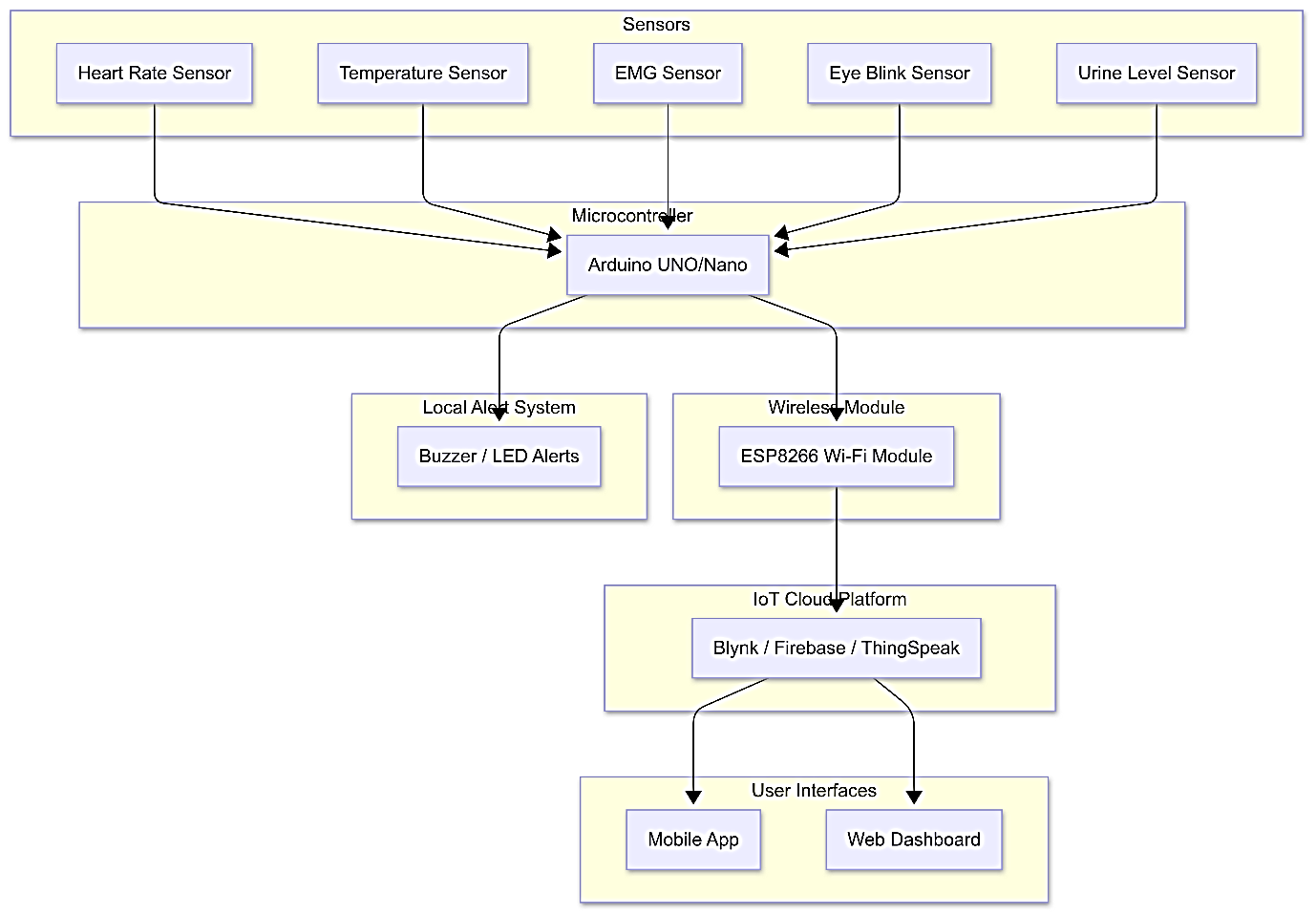
Comatose patients are unable to report discomfort or signal physiological deterioration, so their safety depends entirely on the frequency and reliability of external observation. Conventional practice relies either on manual bedside checks, which are labour-intensive and prone to omission, or on critical-care instrumentation that is expensive and largely unavailable in rural hospitals and home-care settings. This paper presents a low-cost, multi-parameter monitoring framework built on an Arduino Uno acquisition unit and an ESP8266 Wi-Fi module, which together acquire, threshold and publish five physiological indicators: heart rate, body temperature, electromyography (EMG) muscle activity, eye-blink occurrence and urine-bag fill level. The combination of eye-blink detection and urine-output measurement with conventional vital signs distinguishes the design from prior single-purpose monitors, since both parameters are clinically relevant to long-term unconscious patients yet are rarely instrumented together. Threshold logic executes locally on the microcontroller so that buzzer and LED alerts remain available during network loss, while the ESP8266 forwards compact status flags to an IoT dashboard for remote supervision. Bench validation against reference instruments gave heart-rate agreement within ±1 bpm across four comparison points, temperature agreement within ±0.5 °C of a calibrated thermometer, and correct alert actuation at the 80 % urine-bag threshold. The prototype sustained continuous operation over a multi-hour test without loss of data integrity. Two limitations are reported openly: the EMG channel remains susceptible to mains and motion-induced noise, and eye-blink detection is sensitive to sensor alignment relative to the patient’s face. The system is positioned as a complementary early-warning aid rather than a substitute for hospital-grade monitoring.