An IoT Personal-Safety Gadget Integrating Physiological Sensing, Geolocation and Actuated Deterrence
Keywords:
Abstract
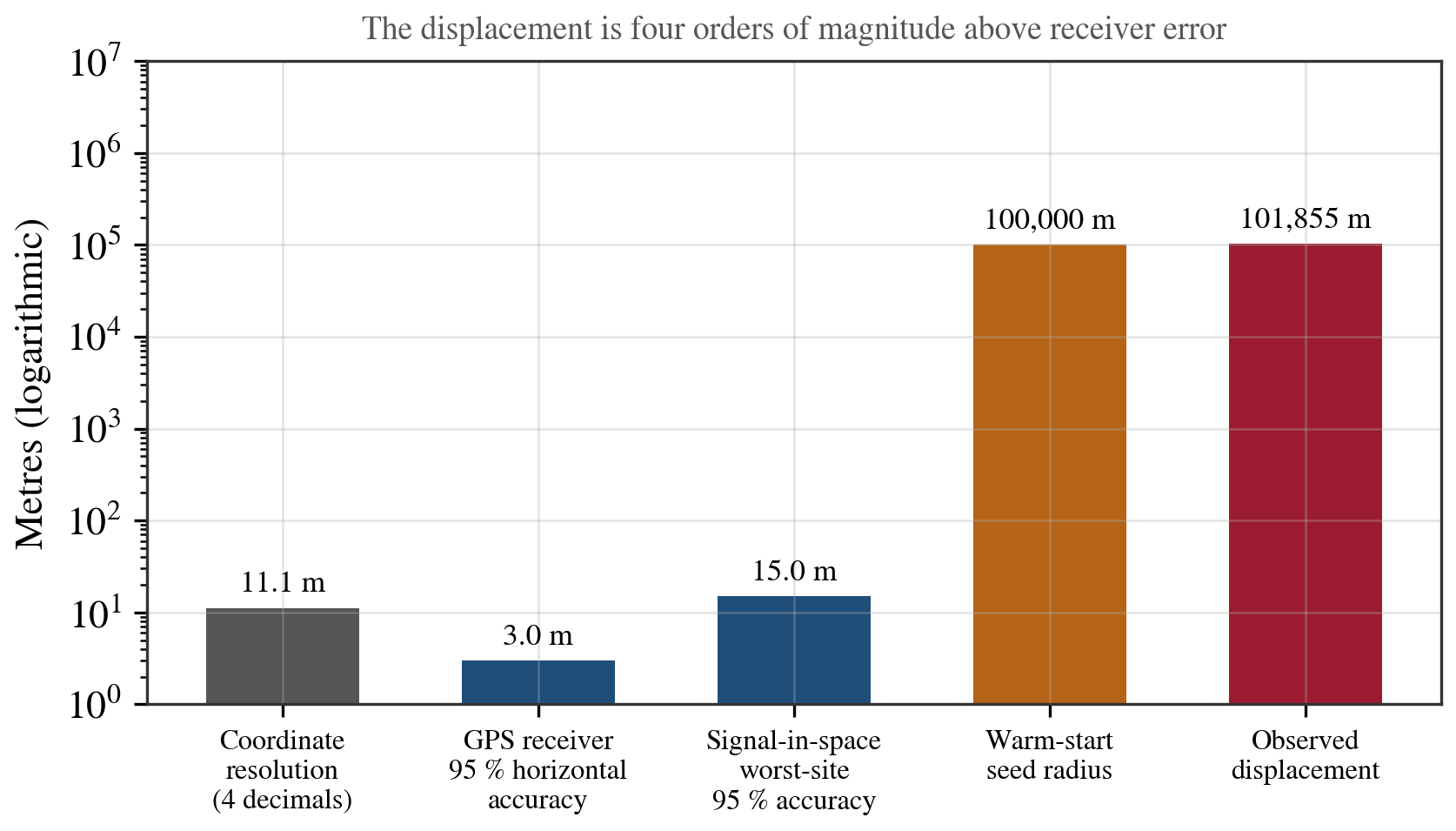
This paper reports the construction and instrumented assessment of a wearable personal-safety node that combines a manual distress trigger, an optical heart-rate sensor, a satellite-navigation receiver, an audible alarm, a camera module and a relay-actuated deterrent, all published to a cloud dashboard over Wi-Fi. The outputs actually captured during the demonstration are reported exactly as recorded: a dashboard reading of 80 BPM with the alarm channel in the ON state, an emergency alert and a separate accident alert raised by device identifier B1371, and a transmitted position of 7.9831 degrees north, 78.3189 degrees east. Three limitations are stated openly. First, the quantity that determines whether such a device is useful, namely the end-to-end latency from trigger to notified contact, was never logged at any stage of the chain, so no response-time figure can be reported and none is invented here. Second, the heart-rate channel was never compared against a reference instrument, so its accuracy, and therefore the credibility of any distress-detection threshold built on it, is unquantified. Third, the single transmitted position is computed here to lie approximately 102 km east-south-east of the institution at which the work was carried out, which is inconsistent with a valid fix at the test site and is reported as an anomaly rather than smoothed over. This revision quantifies that anomaly against published receiver performance: the displacement is roughly four orders of magnitude larger than the 95 % horizontal accuracy of a well-designed receiver, and coincides in magnitude with the position uncertainty a receiver is permitted to hold at warm start, which narrows the candidate explanations. The paper formalises the detection, alerting and localisation relations the architecture presumes, separates measured outputs from built-but-unmeasured capability and from unimplemented design intent, and specifies the exact instrumentation, namely time-stamped event logging, a reference pulse oximeter and a repeated static-fix trial, needed to make the assessment quantitative. Safety, legal and false-alarm considerations attaching to an actuated chemical deterrent are discussed explicitly rather than deferred.