An Efficient Intrusion Detection System Using Data Mining Techniques for Network Security
DOI:
https://doi.org/10.65521/ijaece.v5i1.4557Keywords:
Abstract
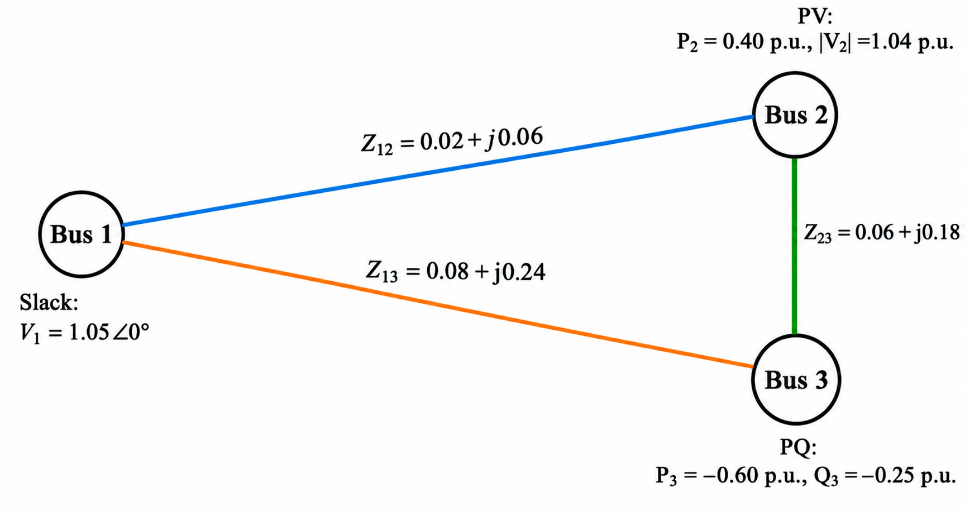
Load flow analysis is a fundamental steady-state study used to determine bus voltages, power injections, transmission-line flows, and system losses for a specified operating condition. This paper presents a step-by-step methodology for solving the AC load-flow problem using the Newton–Raphson (NR) method. The method converts the nonlinear active- and reactive-power equations into a sequence of linear correction equations through the Jacobian matrix. A three-bus test system is used to demonstrate the implementation, including formation of the bus-admittance matrix, selection of initial conditions, mismatch calculation, Jacobian construction, solution of the correction vector, and convergence checking. The numerical example converges in four iterations to a maximum power mismatch below 10⁻¹⁰ p.u. The results illustrate the fast convergence and numerical accuracy that have made the NR method a standard power-flow technique for transmission-system studies. The methodology is also related to earlier developments in Newton-based and decoupled load-flow methods and to later work on computational acceleration and alternative coordinate formulations [1]–[7].