Performance Analysis of IoT-Based Smart Energy Management Systems for Residential Applications
DOI:
https://doi.org/10.65521/ijaece.v11i1.4479Keywords:
Abstract
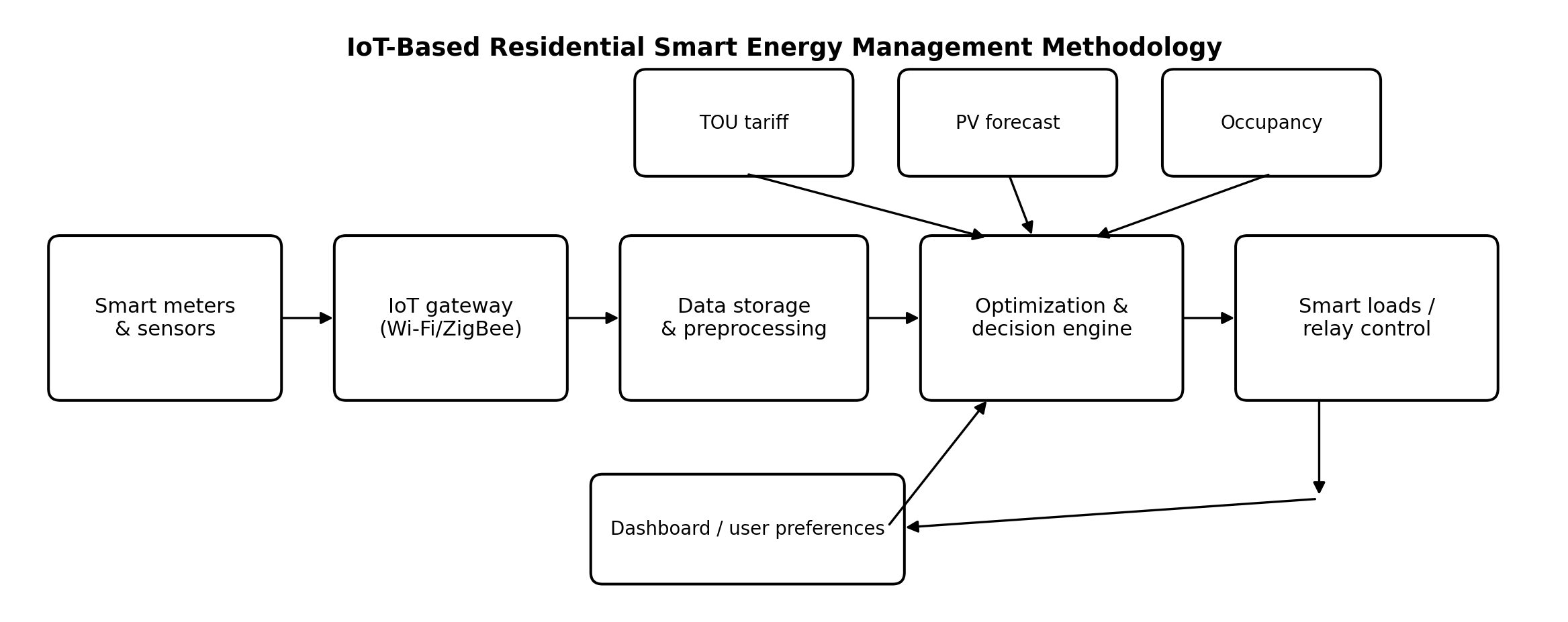
Internet of Things (IoT)-based smart energy management systems (SEMS) provide residential users with continuous visibility and automated control of household electricity consumption. This paper presents a performance-oriented methodology for evaluating an IoT-enabled home energy management system that combines appliance-level sensing, bidirectional communication, time-of-use pricing, occupancy information, renewable-energy awareness, and rule-based load scheduling. The study is formulated as a reproducible 30-day simulation for a representative residence rather than as a claim of completed field experimentation. A baseline operation with uncontrolled appliance use is compared with an IoT-SEMS scenario in which flexible loads are shifted from peak to off-peak periods subject to user-comfort constraints. The principal metrics are daily energy consumption, peak demand, peak-to-average ratio, electricity cost, renewable self-consumption, and control response time. The proposed architecture follows the cyber-physical view of residential energy management in which data acquisition, communication, analytics, and control are tightly integrated (Franco et al., 2022). Modeled results indicate that the evaluated IoT-SEMS can reduce daily grid energy use by approximately 18.8%, lower peak demand by 26.2%, decrease electricity cost by 21.3%, and increase local photovoltaic utilization while maintaining appliance-service windows. These results are consistent with earlier work showing that monitoring, scheduling, occupancy awareness, and renewable/storage coordination are central to effective smart-home energy management (Badar & Anvari-Moghaddam, 2022; Natarajan et al., 2022). The methodology is intended as a compact framework for comparing residential IoT energy-management strategies under transparent assumptions.