Design and Performance Evaluation of Grid-Connected Solar Photovoltaic Systems Using Advanced MPPT Techniques
DOI:
https://doi.org/10.65521/ijaece.v11i1.4477Keywords:
Abstract
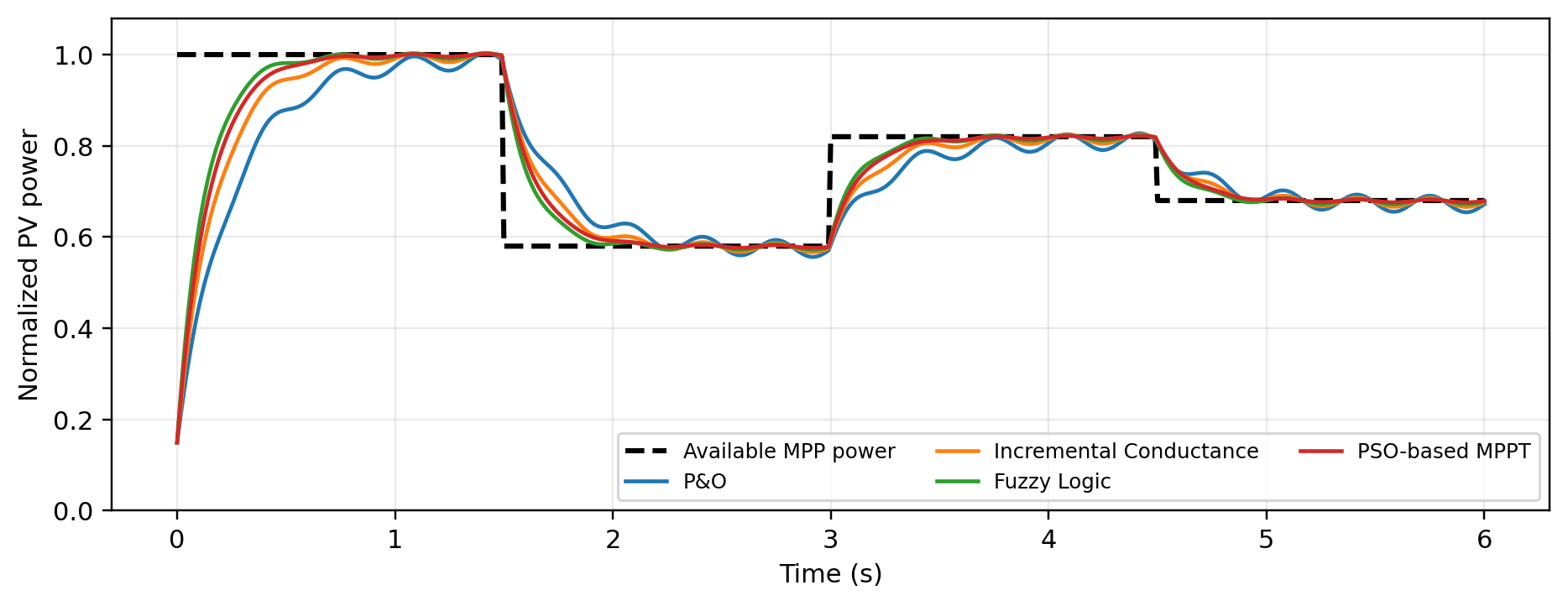
Grid-connected photovoltaic (PV) systems require coordinated maximum power point tracking (MPPT), DC-link regulation, and grid-current control to convert intermittent solar energy into stable electrical power. This methodology paper develops a simulation-oriented framework for designing and evaluating a two-stage grid-connected PV system using four MPPT strategies: perturb and observe (P&O), incremental conductance (INC), fuzzy logic control (FLC), and particle swarm optimization (PSO). The proposed system comprises a PV array, boost converter, DC-link capacitor, voltage-source inverter, filter, and phase-locked-loop-based grid interface. Performance is evaluated under step changes in irradiance using tracking efficiency, settling time, steady-state power ripple, and implementation complexity. A standardized numerical benchmark is used so that the algorithms are compared under identical PV and converter conditions. The representative results indicate that P&O provides the simplest implementation but exhibits the largest oscillation near the maximum power point, while INC improves dynamic tracking. FLC reduces transient error through adaptive control, and PSO gives the highest energy-capture accuracy at the cost of greater computation. The framework also highlights the importance of decoupling PV-side MPPT design from grid-side current regulation and of validating advanced algorithms against dynamic irradiance profiles rather than only steady-state conditions. The study provides a reproducible methodology for selecting MPPT strategies for small and medium grid-connected PV installations.