Performance Evaluation of MIMO Techniques for Next-Generation Wireless Communication Systems
DOI:
https://doi.org/10.65521/ijaece.v10i1.4472Keywords:
Abstract
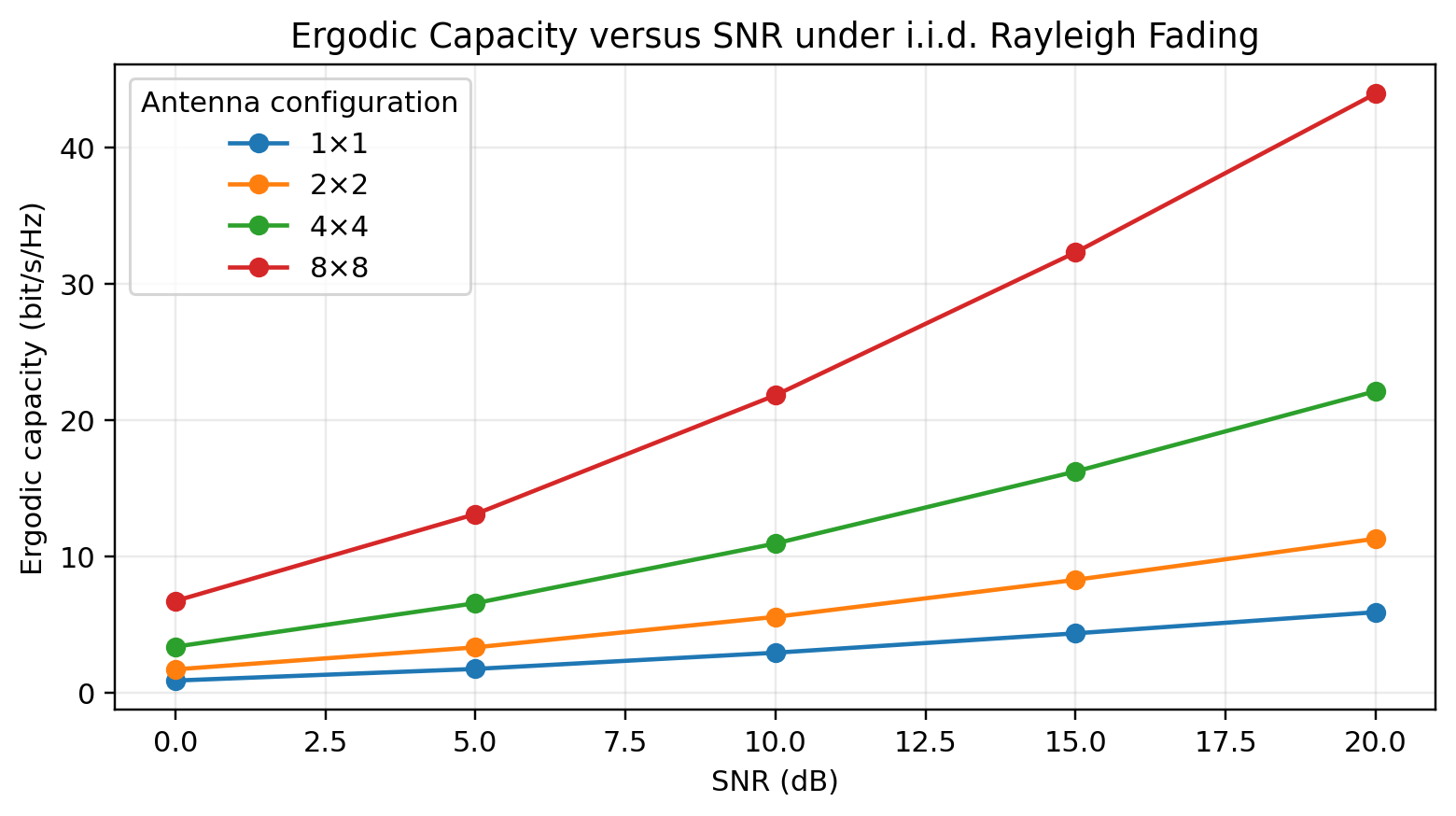
Multiple-input multiple-output (MIMO) transmission is a central mechanism for increasing the reliability, spectral efficiency, and peak data rate of modern wireless networks. This methodology paper evaluates how antenna scaling changes the achievable performance of wireless links and connects classical MIMO principles with the requirements of next-generation 5G/6G systems. A simulation-based framework is developed for SISO, 2×2, 4×4, and 8×8 configurations over independent Rayleigh flat-fading channels. Equal power allocation and perfect receiver channel-state information are assumed, while ergodic capacity, lower-tail capacity, and outage probability are used as the principal performance measures. Twenty thousand independent channel realizations are generated at SNR values from 0 to 20 dB. The results show a strong and nearly proportional capacity increase with the number of spatial dimensions under ideal uncorrelated fading: at 10 dB, mean capacity increases from about 2.91-bit/s/Hz for SISO to 5.54-, 10.93-, and 21.81-bit/s/Hz for 2×2, 4×4, and 8×8 MIMO, respectively. The analysis also shows that additional antennas reduce outage risk by hardening the distribution of achievable rates. These findings support the use of spatial multiplexing, large arrays, and adaptive beamforming in next-generation networks while emphasizing that practical gains depend on channel correlation, channel estimation, radio-frequency complexity, and interference management.