Comparative Analysis of MPPT Techniques for Solar Photovoltaic Energy Conversion Systems
DOI:
https://doi.org/10.65521/ijaece.v9i1.4465Keywords:
Abstract
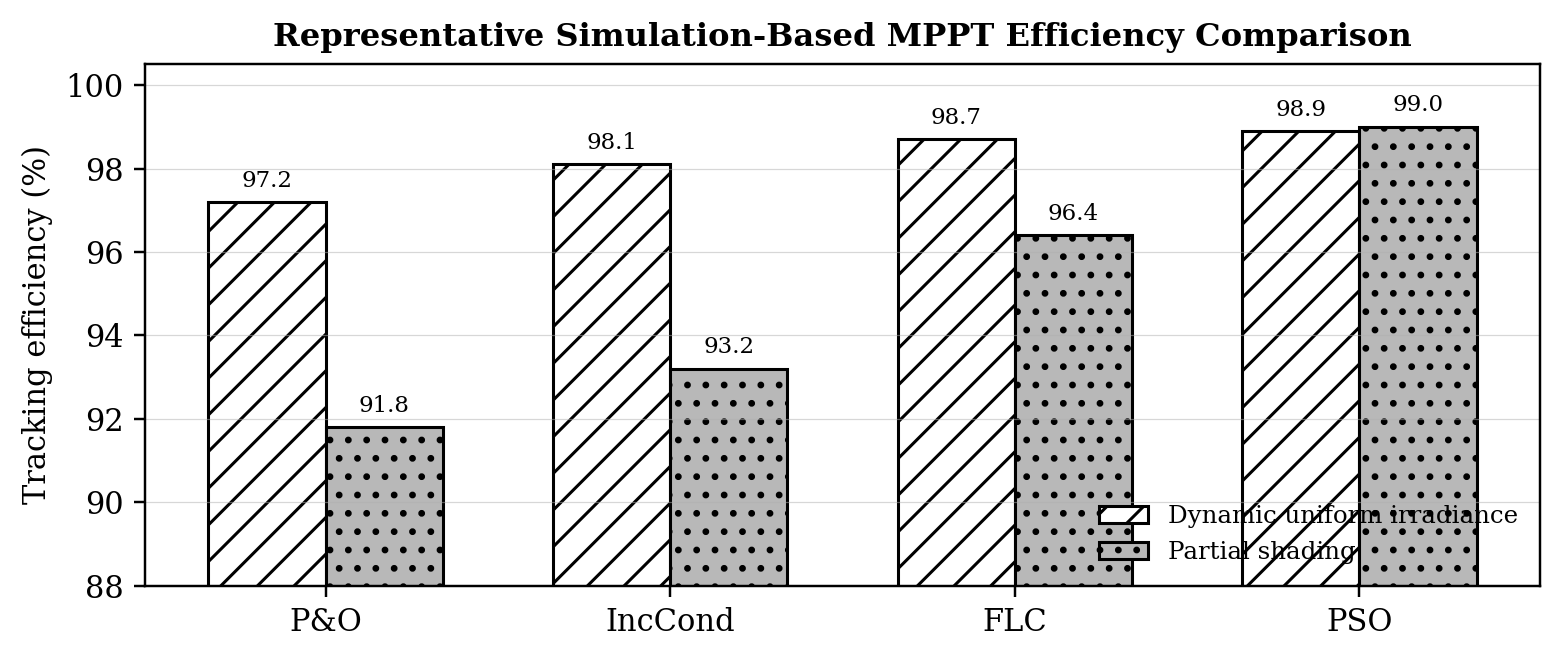
Maximum power point tracking (MPPT) is essential in solar photovoltaic (PV) energy conversion because the electrical operating point of a PV array changes continuously with irradiance, temperature, and shading. This methodology paper develops a common simulation framework for comparing four representative MPPT strategies: Perturb and Observe (P&O), Incremental Conductance (IncCond), Fuzzy Logic Control (FLC), and Particle Swarm Optimization (PSO). A single-diode PV model, a DC-DC boost converter, identical sensing and sampling conditions, and three environmental test scenarios are used so that algorithmic behavior can be compared without hardware-related bias. The evaluation criteria are MPPT efficiency, settling time, steady-state power ripple, response to rapid irradiance variation, capability under partial shading, implementation complexity, and sensor/computational requirements. The representative simulation benchmark indicates that conventional P&O remains attractive because of its simplicity, while IncCond provides improved dynamic discrimination. FLC reduces oscillation and improves transient response, whereas PSO gives the strongest global maximum tracking under partial shading at the expense of computational burden. The study therefore shows that MPPT selection should be application-dependent rather than based on a single efficiency value. The proposed methodology provides a reproducible basis for selecting MPPT techniques for low-cost standalone systems, rapidly varying rooftop PV installations, and PV arrays exposed to non-uniform irradiance.