Optimization of Power Distribution Losses Using Intelligent Control Techniques
DOI:
https://doi.org/10.65521/ijaece.v8i1.4458Keywords:
Abstract
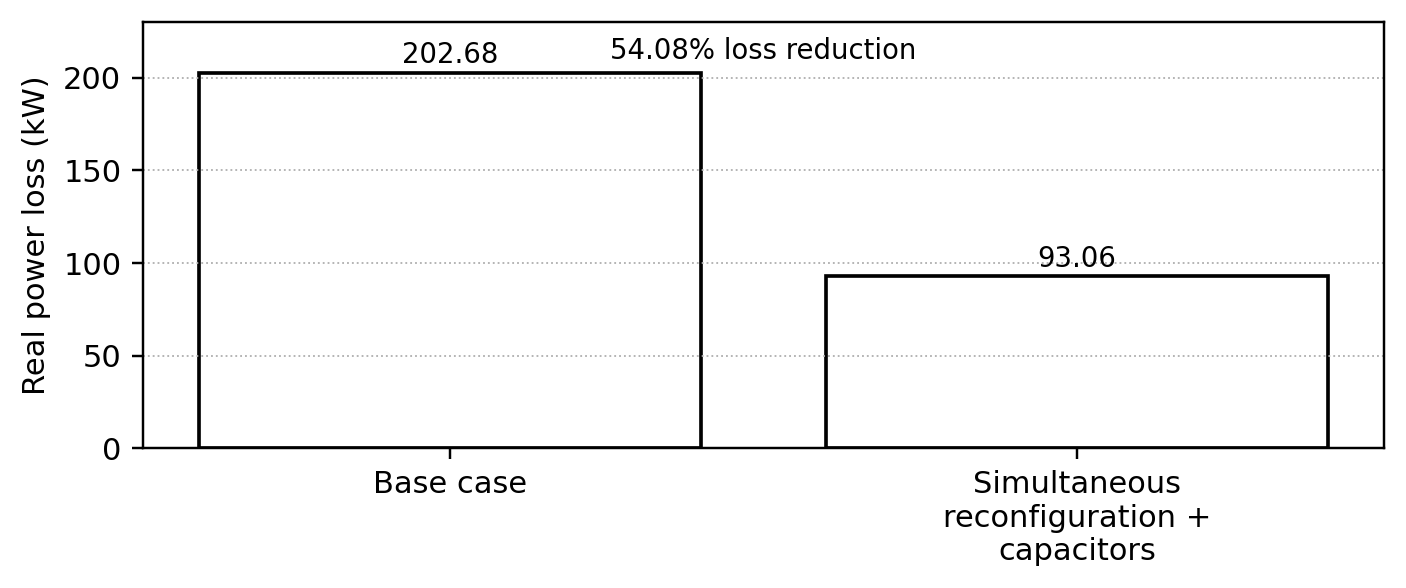
Electrical distribution networks experience substantial technical losses because of conductor resistance, reactive-power circulation, non-optimal feeder topology, and uneven loading. This paper develops a compact methodology for optimizing distribution losses through intelligent control techniques. The proposed framework integrates radial distribution load-flow analysis with network reconfiguration and reactive-power compensation, while intelligent optimizers search for feasible switch states and capacitor locations/sizes. Genetic algorithm (GA), particle swarm optimization (PSO), fuzzy multi-objective control, harmony search, ant-colony-based search, and hybrid schemes are treated as candidate controllers. The principal objective is the minimization of total real power loss subject to bus-voltage, branch-current, radiality, and load-supply constraints. The IEEE 33-bus radial distribution system is adopted as the principal benchmark because it is widely used for loss-minimization studies. A literature-aligned validation shows that simultaneous intelligent reconfiguration and capacitor placement can reduce the benchmark loss from 202.68 kW to approximately 93.06 kW, corresponding to about 54.08% reduction, while also improving the voltage profile. The methodology emphasizes repeatable power-flow evaluation, constraint handling, convergence testing, and fair algorithm comparison. The study concludes that hybrid intelligent control is more effective than isolated corrective actions because it jointly controls network topology and reactive-power support.