Comparative Analysis of PID and Fuzzy Logic Controllers for DC Motor Speed Control
DOI:
https://doi.org/10.65521/ijaece.v7i1.4330Keywords:
Abstract
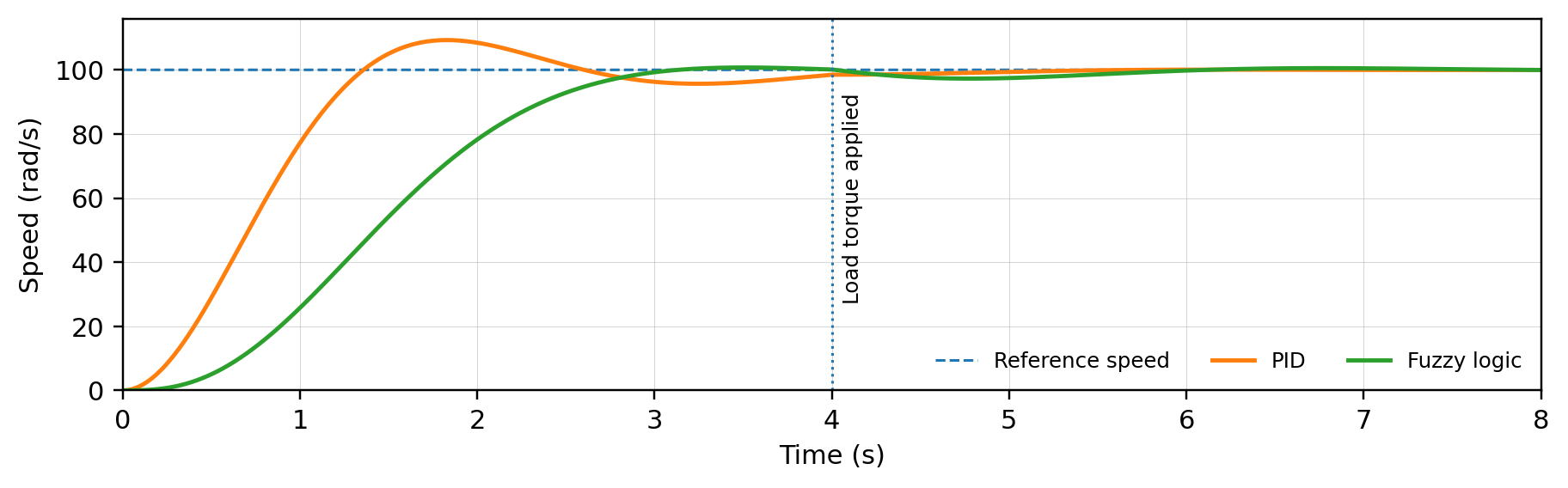
This methodology paper presents a controlled comparative study of a conventional proportional–integral–derivative (PID) controller and a fuzzy logic controller (FLC) for the speed regulation of an armature-controlled direct-current (DC) motor. The comparison is organized so that both controllers operate on the same electromechanical motor model, voltage constraint, reference-speed command, and load-disturbance scenario. The PID controller is tuned with fixed gains, whereas the FLC uses normalized speed error and change of error with symmetric linguistic membership functions and a rule-based incremental control action. Performance is evaluated through rise time, settling time, maximum overshoot, steady-state error, and disturbance deviation. A reproducible numerical simulation is used to illustrate the methodology. The representative results show that PID gives the faster initial rise, while the fuzzy controller substantially reduces overshoot and reaches the ±2% settling band earlier with a smaller steady-state tracking error. The comparison supports the use of PID where simplicity and fast nominal response dominate, and fuzzy control where response smoothness and tolerance to nonlinear or uncertain operating behavior are more important. All cited literature is from 2018 or earlier and each reference includes a DOI.