Performance Analysis of Fuzzy Logic-Based Speed Control of Three-Phase Induction Motors
DOI:
https://doi.org/10.65521/ijaece.v6i1.4326Keywords:
Abstract
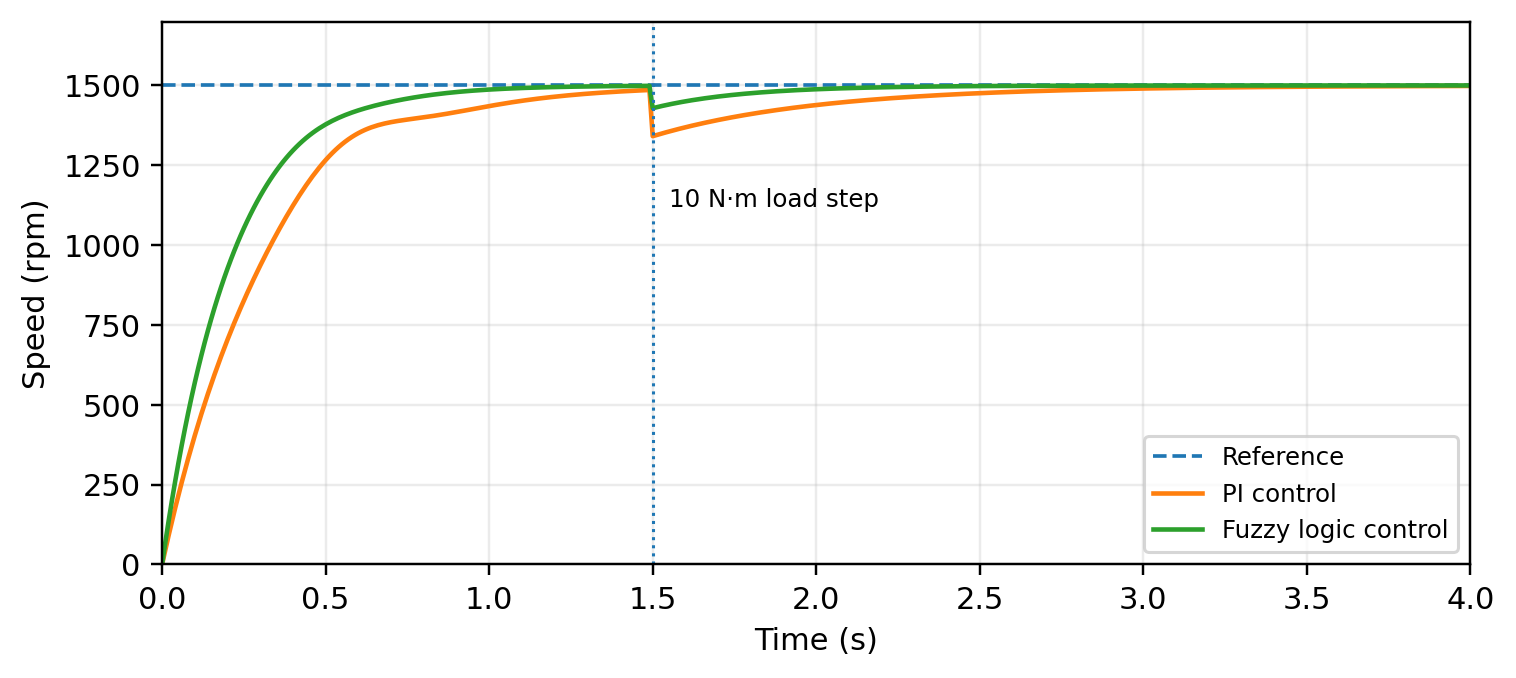
Three-phase induction motors are extensively employed in pumps, fans, conveyors, machine tools, and industrial process drives because of their rugged construction and low maintenance. Their nonlinear, multivariable dynamics, however, make precise speed regulation difficult when the load changes or motor parameters vary. This methodology paper presents a fuzzy logic controller (FLC) for the outer speed-control loop of a vector-controlled three-phase induction motor and compares its behavior with a conventional proportional-integral (PI) controller. The controller uses speed error and changes in speed error as linguistic inputs and generates a torque-producing current command through Mamdani inference and centroid defuzzification. A MATLAB/Simulink-oriented experimental methodology is specified using a 2.2 kW, 400 V, 50 Hz squirrel-cage induction motor model, a PWM voltage-source inverter, and a rotor-flux-oriented control structure. Performance is evaluated for step changes in speed reference and a sudden load-torque disturbance. Representative simulation results indicate faster settling, lower overshoot, reduced speed dip, and smaller steady-state tracking error for the fuzzy controller. The study demonstrates why rule-based fuzzy control is attractive when accurate parameter tuning is difficult and operating conditions change. The reported numerical values are simulation outcomes for the defined model and should be validated experimentally before hardware deployment.