Development of Wireless Sensor Network-Based Industrial Temperature Monitoring Systems
DOI:
https://doi.org/10.65521/ijaece.v6i1.4325Keywords:
Abstract
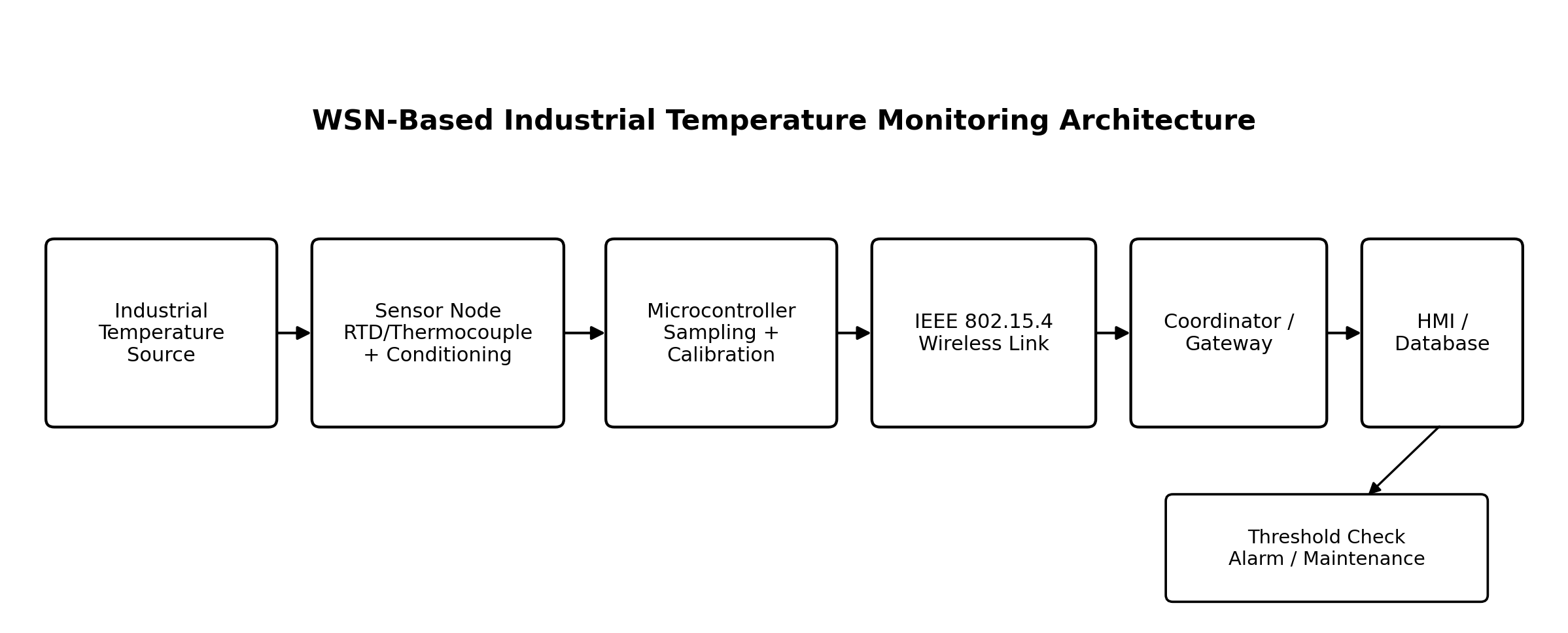
Industrial temperature is a critical condition variable because abnormal heating can indicate excessive load, lubrication failure, insulation deterioration, process instability, or unsafe operating conditions. This paper develops a methodology for a wireless sensor network (WSN)-based industrial temperature monitoring system that acquires temperature at distributed locations, performs local calibration and filtering, transmits data through a low-power wireless link, and presents the measurements at a central human-machine interface (HMI). The proposed design combines temperature sensors, signal-conditioning circuits, a microcontroller, an IEEE 802.15.4-class radio, a coordinator/gateway, database logging, and threshold-based alarms. The methodology emphasizes industrial constraints including interference, packet loss, sensor accuracy, power consumption, scalability, and maintainability. A star topology is adopted for the base prototype because it reduces configuration complexity, while the architecture can be extended to mesh communication for larger installations. The validation procedure includes sensor calibration, communication-range testing, packet-delivery assessment, alarm verification, and measurement-error analysis. A representative bench-validation dataset is included to demonstrate how the performance metrics should be reported when implementing the design. The proposed system provides a practical framework for replacing long sensor cabling with modular wireless sensing while retaining the reliability and traceability required for industrial monitoring applications.