Design and Evaluation of Low-Cost Uninterruptible Power Supply Systems for Residential Applications
DOI:
https://doi.org/10.65521/ijaece.v6i1.4324Keywords:
Abstract
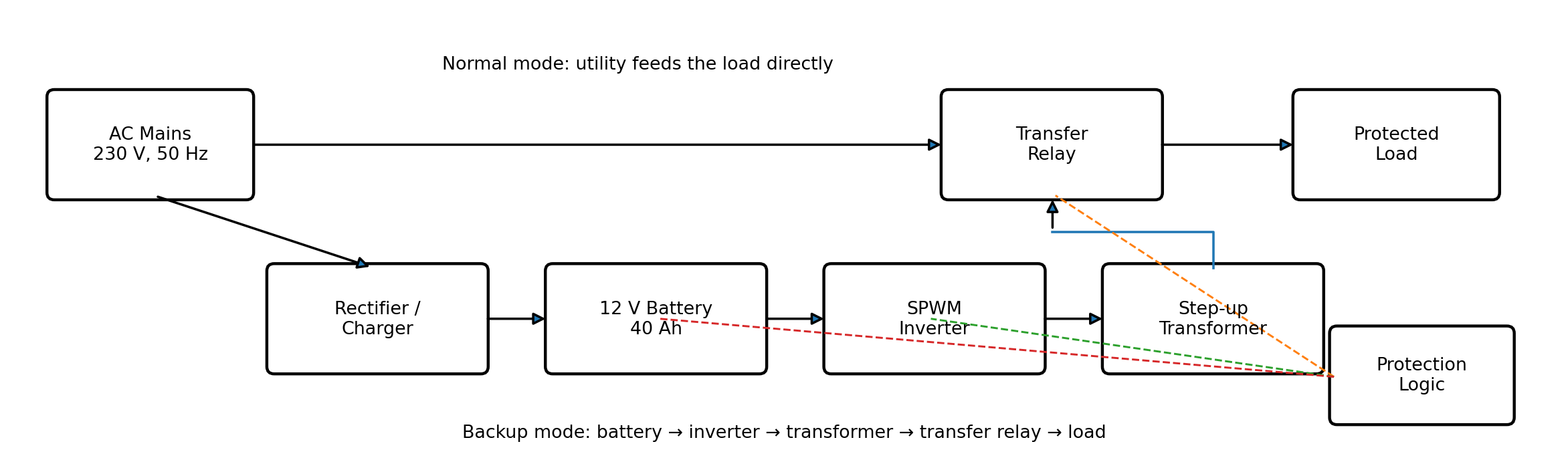
This paper presents a practical methodology for designing and evaluating a low-cost single-phase uninterruptible power supply (UPS) intended for essential residential loads such as LED lighting, a fan, a router, and small electronic equipment. The proposed configuration uses a standby/line-interactive operating concept because this class offers lower component count, lower conduction loss, and simpler control than double-conversion online systems while still providing short-duration backup and basic voltage protection. The design is rated at 600 VA with a recommended continuous real-power load of 300–360 W, a 12 V battery bank, a sinusoidal pulse-width-modulated inverter, an isolated step-up transformer, a relay-based transfer stage, and low-voltage protection. The methodology covers requirement definition, topology selection, inverter and transformer sizing, battery sizing, charger selection, protection logic, test conditions, and performance metrics. Design-level evaluation indicates an expected full-load output regulation within approximately ±2%, inverter efficiency in the mid-80% range, a transfer interval below 10 ms when an appropriately selected relay and control stage are used, and practical backup durations of about 40–70 min for 200–300 W residential loads depending on battery condition and discharge rate. The study shows that cost reduction is most effectively achieved through topology simplification, appropriate component derating, and limiting the UPS to essential loads rather than oversizing the system for an entire dwelling.