Power Quality Improvement in Distribution Systems Using FACTS-Based Compensation Techniques
DOI:
https://doi.org/10.65521/ijaece.v5i1.4320Keywords:
Abstract
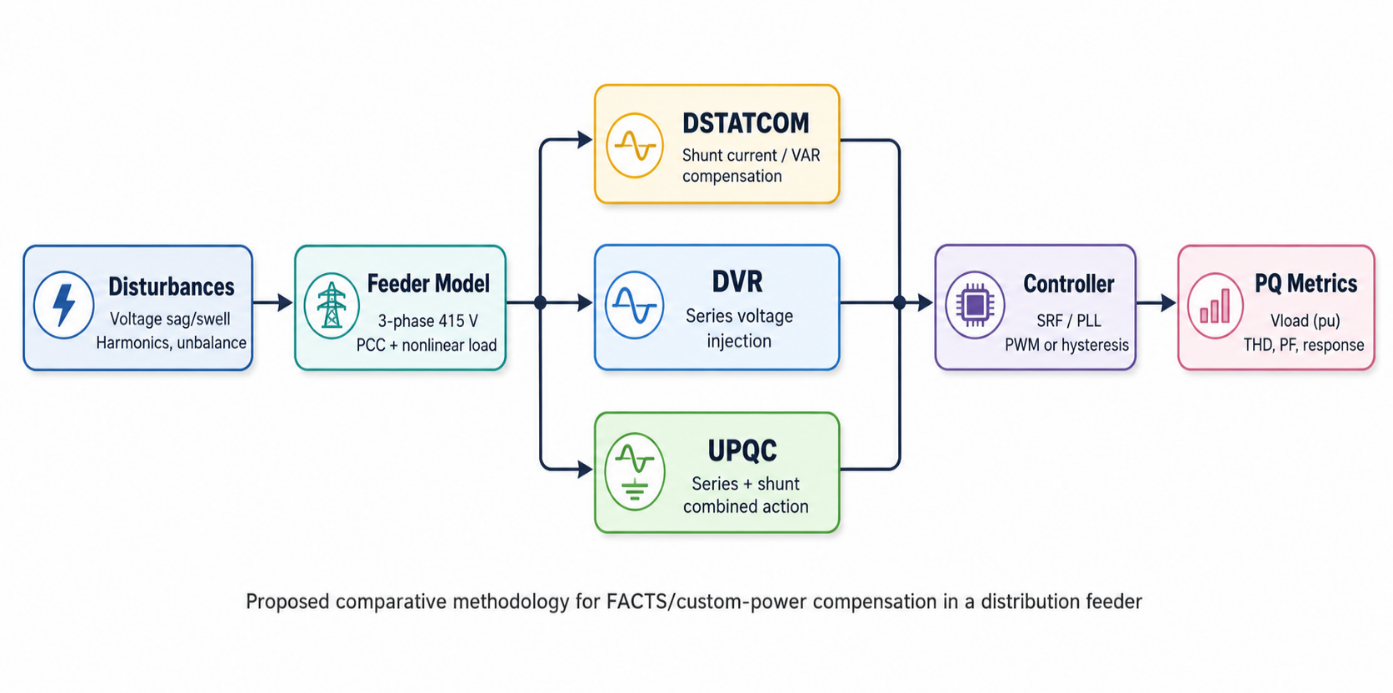
This methodology paper develops a comparative framework for improving power quality in radial distribution systems using power-electronic compensation techniques derived from Flexible AC Transmission Systems (FACTS) and custom-power concepts. The study considers the Distribution Static Synchronous Compensator (DSTATCOM), Dynamic Voltage Restorer (DVR), and Unified Power Quality Conditioner (UPQC) because they represent shunt, series, and combined series-shunt compensation, respectively. A three-phase distribution feeder supplying nonlinear and unbalanced loads is modeled under voltage sag, swell, harmonic current, and reactive-power disturbances. Each compensator is evaluated using a common synchronous-reference-frame control basis so that differences in performance can be attributed mainly to converter placement and compensation function. The evaluation criteria are load-voltage retention, source-current total harmonic distortion (THD), power factor, and dynamic response. The proposed comparison indicates that DSTATCOM is most effective for current harmonics and reactive-power support, DVR gives direct and economical voltage-sag correction for sensitive loads, while UPQC provides the broadest simultaneous mitigation of voltage- and current-related disturbances at the cost of greater converter rating and control complexity. The methodology is suitable for MATLAB/Simulink implementation and provides a reproducible basis for selecting compensation equipment for distribution-level power-quality applications.