Hybrid Deep Learning Optimization for Dual-Stage Interleaved EV Onboard Charger Systems
Keywords:
Abstract
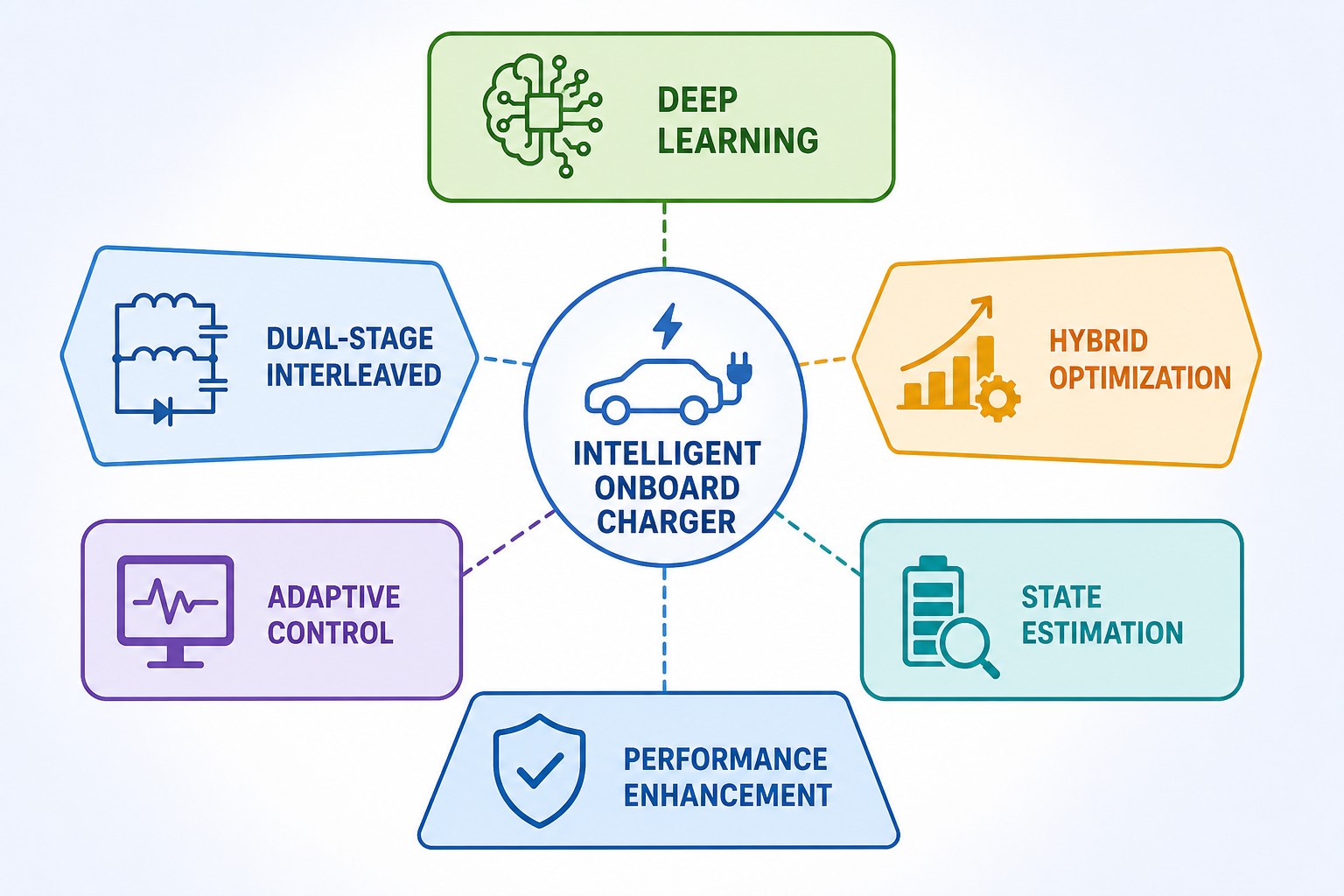
The rapid adoption of electric vehicles has intensified the demand for efficient, adaptive, and intelligent onboard charging systems capable of meeting stringent performance and grid compliance requirements. Dual-stage interleaved onboard chargers have emerged as a preferred architecture due to their ability to achieve high power factor, reduced current ripple, galvanic isolation, and improved efficiency across varying battery conditions. This paper presents a comprehensive review of advanced control and optimization techniques applied to dual-stage interleaved onboard chargers. It highlights the integration of deep learning approaches, including convolutional neural networks, recurrent models, and reinforcement learning, for tasks such as real-time control, fault detection, and battery state estimation. Additionally, the study focuses on the Hybrid Adaptive Genghis Khan Shark Gold Rush (HAGKSGR) algorithm for optimizing PIDD2-PD controllers, enabling improved transient response, reduced overshoot, and enhanced robustness in nonlinear operating environments. Applications include high-performance electric vehicle charging systems, vehicle-to-grid integration, and intelligent energy management. Comparative analyses demonstrate that deep learning-assisted and metaheuristic-optimized controllers outperform conventional methods in efficiency, adaptability, and accuracy. However, challenges such as computational complexity, real-time deployment, and hardware constraints remain. This review emphasizes the potential of combining deep learning and hybrid optimization techniques to develop next-generation intelligent onboard charging systems.