Comparative Study of Load Balancing Techniques in Virtualized Cloud Computing Environments
DOI:
https://doi.org/10.65521/ijacte.v8i1.4632Keywords:
Abstract
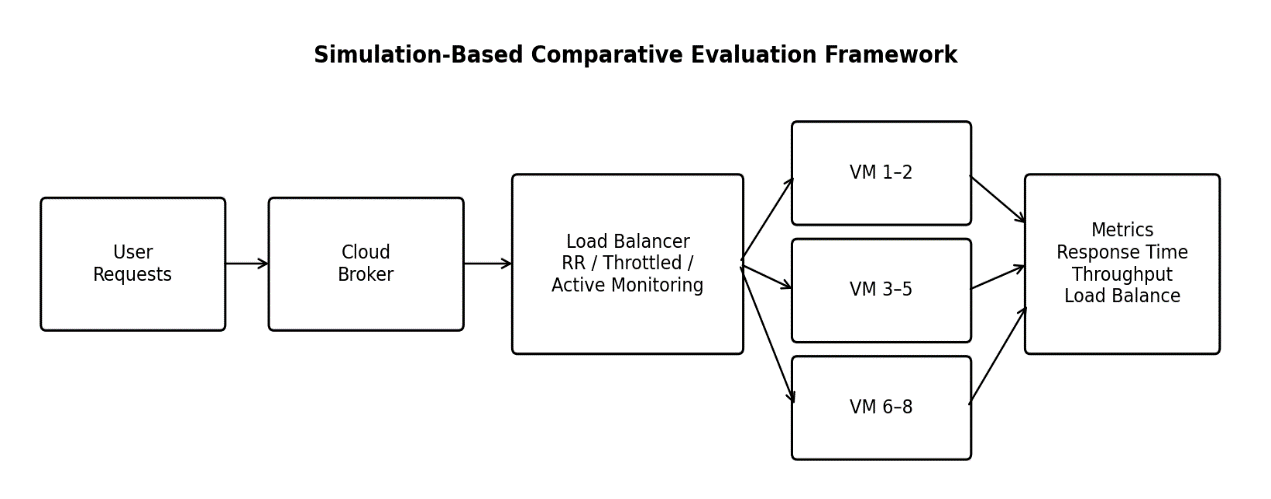
Load balancing is a core resource-management function in virtualized cloud computing because uneven allocation of requests can increase response time, create virtual-machine (VM) hot spots, and reduce infrastructure efficiency. This paper presents a simulation-based methodology for comparing three widely used VM-level load-balancing techniques: Round Robin, Throttled, and Active Monitoring (also described as Equally Spread Current Execution in several CloudAnalyst studies). A common heterogeneous virtualized environment is defined so that every algorithm receives the same arrival stream, task sizes, and VM capacities. The evaluation uses mean response time, 95th-percentile response time, average waiting time, throughput, and utilization imbalance as primary performance measures. In the controlled experiment, the capacity-aware Throttled policy produced the lowest average response time, whereas Active Monitoring produced the most even utilization across heterogeneous VMs. Round Robin remained simple and predictable but showed weaker performance when equal task counts were assigned to machines with unequal processing capacity. The study demonstrates that the preferred technique depends on whether the design objective emphasizes latency, load fairness, implementation simplicity, or energy-aware consolidation rather than a single universal criterion.