Secure Authentication Mechanisms for Cloud-Based Computing Environments
DOI:
https://doi.org/10.65521/ijacte.v7i1.4630Keywords:
Abstract
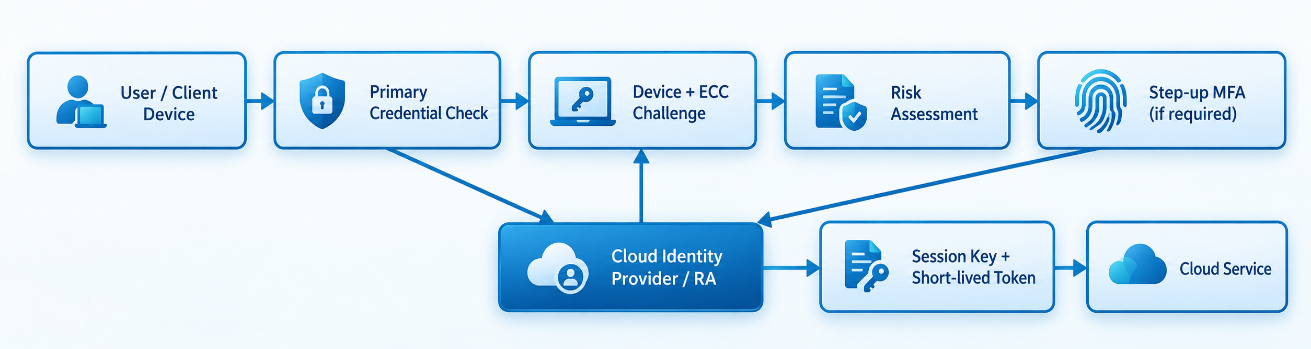
Cloud computing allows users to obtain software, platforms, storage and processing resources on demand, but the same distributed and multi-tenant model creates serious authentication risks. Password-only login is inadequate when credentials are stolen, replayed, guessed or used from an untrusted device. This methodology paper develops a secure authentication framework for cloud-based computing environments by integrating primary credentials, device-bound cryptographic proof, risk-aware multi-factor authentication, mutual verification, session-key establishment and role-based authorization. The method is derived from peer-reviewed research published up to 2018 and is evaluated through a structured threat model and an analytical security-cost comparison. The proposed design applies nonce-based freshness, elliptic-curve key agreement, step-up one-time-password or biometric verification, short-lived access tokens and centralized revocation. Analytical results show that the framework covers eight major authentication and access-control requirements while keeping the normal login path lighter than an always-on high-cost multi-factor design. The study concludes that layered, adaptive authentication provides a better security-usability balance than a single authentication factor and is suitable as a reference methodology for cloud applications requiring scalable access control and stronger resistance to credential compromise.