Design and Development of an Intelligent Web-Based Recommendation System Using Collaborative Filtering
DOI:
https://doi.org/10.65521/ijacte.v7i1.4629Keywords:
Abstract
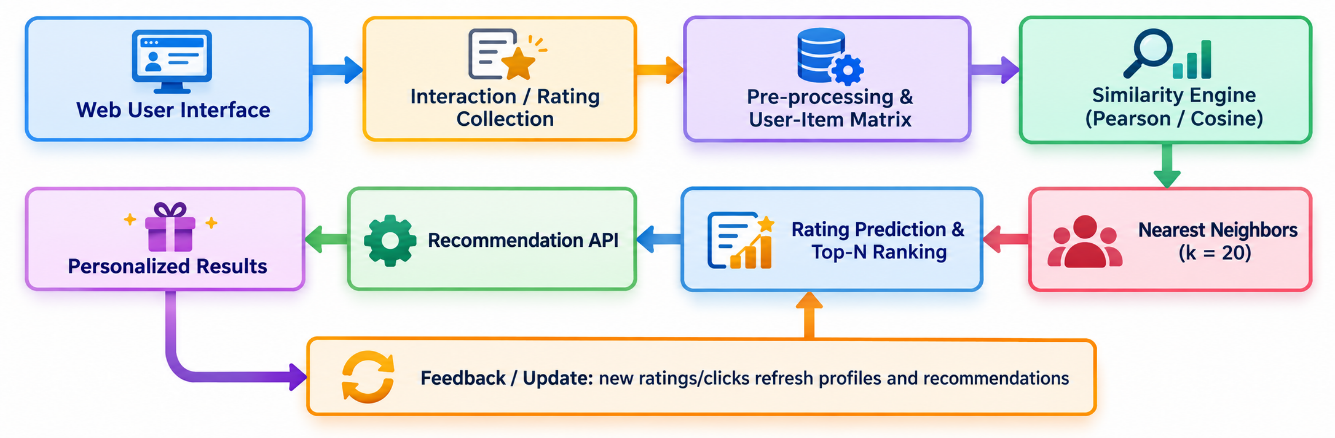
Recommender systems reduce information overload by predicting items that are likely to match an individual user’s preferences. This methodology paper presents the design and development of an intelligent web-based recommendation system centered on collaborative filtering (CF). The proposed system captures explicit ratings and implicit interaction signals through a browser interface, converts them into a sparse user-item matrix, computes similarity among users or items, selects nearest neighbors, estimates unknown ratings, and returns a ranked Top-N list through a recommendation service. The design emphasizes modular web integration, explainable neighborhood-based prediction, continuous feedback, and evaluation with mean absolute error (MAE) and root mean square error (RMSE). A controlled synthetic prototype experiment using 300 users, 250 items, 10,520 observed 1–5 ratings, an 80:20 train-test split, and k=20 neighbors was used to demonstrate the evaluation procedure. User-based CF achieved an MAE of 0.638 and RMSE of 0.797, while item-based CF achieved 0.643 and 0.801 respectively, both improving on a global-mean baseline. The methodology provides a practical foundation for web commerce, digital libraries, learning portals, and media platforms while retaining compatibility with later extensions such as matrix factorization, context-aware filtering, and hybrid recommendation.