A Comparative Study of Machine Learning Algorithms for Predictive Data Analytics
DOI:
https://doi.org/10.65521/ijacte.v7i1.4628Keywords:
Abstract
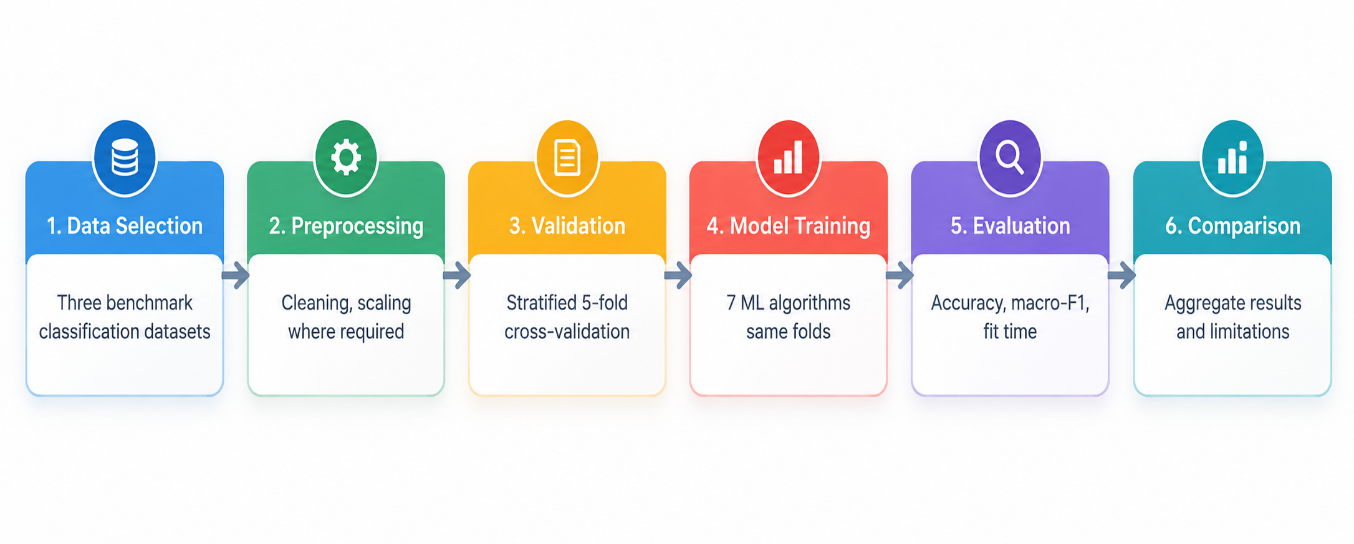
Predictive data analytics uses historical observations to estimate future classes, outcomes, or risks, but the quality of a prediction depends strongly on the learning algorithm, data representation, and evaluation procedure. This study presents a controlled comparison of seven widely used supervised machine learning algorithms: logistic regression, decision tree, random forest, support vector machine (SVM), k-nearest neighbours (k-NN), Gaussian naive Bayes, and gradient boosting. A common experimental pipeline is applied to three established classification datasets distributed with scikit-learn. Scale-sensitive models are standardized, while all models are evaluated using identical stratified five-fold cross-validation splits. Accuracy, macro-averaged F1 score, and model fitting time are used as comparative criteria. The observed results show that SVM, logistic regression, k-NN, and random forest provide consistently strong predictive accuracy in this limited benchmark, while simpler probabilistic and single-tree approaches vary more across datasets. The study also emphasizes that no algorithm is universally superior; algorithm selection should consider data characteristics, computational cost, interpretability, and the cost of prediction errors. The proposed methodology provides a reproducible framework for comparative predictive analytics without relying on a single dataset or a single performance measure.