Performance Evaluation of Routing Protocols in Mobile Ad Hoc Networks (MANETs)
DOI:
https://doi.org/10.65521/ijacte.v4i1.4599Keywords:
Abstract
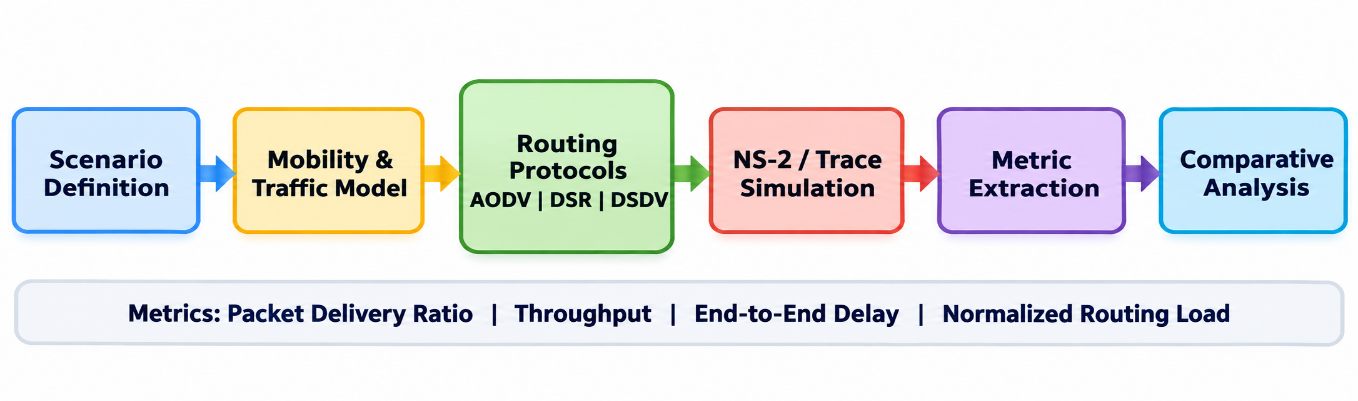
Mobile Ad Hoc Networks (MANETs) provide infrastructure-free communication through mobile nodes that act simultaneously as hosts and routers. Their changing topology, constrained wireless bandwidth, and frequent link failures make routing performance strongly dependent on mobility, traffic load, and network size. This methodology paper defines a reproducible framework for evaluating three representative MANET routing protocols: Ad Hoc On-Demand Distance Vector (AODV), Dynamic Source Routing (DSR), and Destination-Sequenced Distance-Vector (DSDV). The proposed evaluation uses controlled simulation scenarios, a Random Waypoint mobility model, IEEE 802.11 medium access, UDP/CBR traffic, repeated random seeds, and four metrics: packet delivery ratio, throughput, average end-to-end delay, and normalized routing load. The literature indicates that reactive protocols often preserve delivery more effectively under mobility, while proactive DSDV can provide low route acquisition delay at the cost of periodic control traffic. The methodology therefore emphasizes scenario-specific interpretation rather than a universal protocol ranking.