Performance Analysis of Energy-Efficient Routing Protocols in Wireless Sensor Networks
DOI:
https://doi.org/10.65521/ijacte.v8i1.4634Keywords:
Abstract
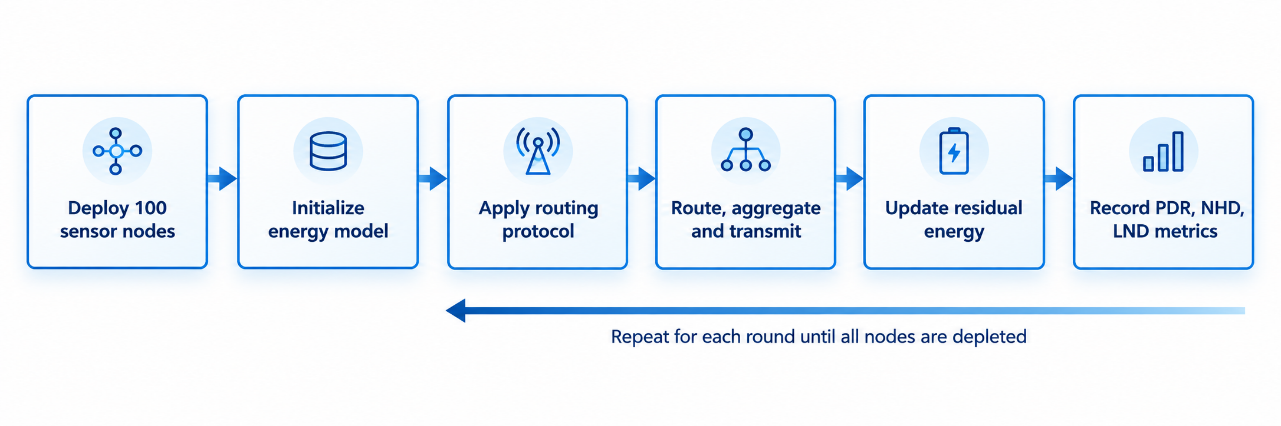
Wireless sensor networks (WSNs) operate with small battery-powered nodes whose lifetime is strongly influenced by the routing strategy used to deliver sensed information to a base station. This paper presents a simulation-based methodology for analyzing four widely studied energy-efficient routing protocols: Low-Energy Adaptive Clustering Hierarchy (LEACH), Power-Efficient Gathering in Sensor Information Systems (PEGASIS), Hybrid Energy-Efficient Distributed clustering (HEED), and Distributed Energy-Efficient Clustering (DEEC). A common first-order radio-energy model, identical network geometry, packet size, and initial energy are used to provide a controlled comparison. Performance is evaluated through first-node death (FND), half-node death (HND), last-node death (LND), residual-energy behavior, and routing characteristics. Five simulation runs are averaged for the reported lifetime indicators. The representative results show that protocol design changes the distribution of energy consumption substantially: HEED provides the longest stability period before the first node failure, while PEGASIS achieves the longest HND and LND in the selected scenario. The methodology emphasizes reproducible assumptions, common metrics, and fair initialization so that routing protocols can be compared without mixing incompatible experimental conditions.