Design and Implementation of a Web-Based E-Learning Management System
DOI:
https://doi.org/10.65521/ijacte.v6i1.4595Keywords:
Abstract
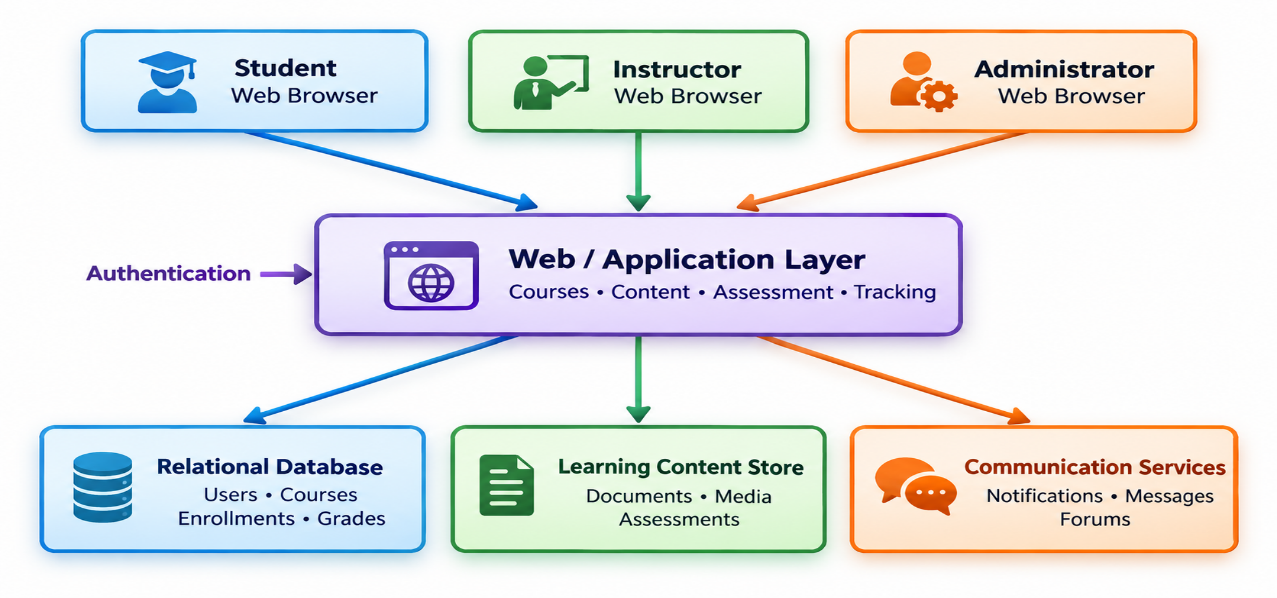
Web-based e-learning management systems integrate instructional content, learner administration, communication, assessment, and progress monitoring within a browser-accessible environment. This methodology paper presents a compact, reproducible approach for designing and implementing such a system for higher-education use. The proposed method begins with stakeholder and functional requirement analysis, proceeds through role-based three-tier architecture and relational data modelling, and then defines modules for course management, learning materials, enrolment, assessment, communication, reporting, and security. The design is informed by established studies on virtual learning environments, e-learning success, learner satisfaction, pedagogical quality, and learning-management-system adoption. A structured verification matrix is used to evaluate requirement coverage rather than claiming unobserved learning gains. The proposed architecture separates presentation, application logic, persistent data, and content storage, thereby supporting maintainability and controlled access for administrators, instructors, and students. Design-level results show complete traceability of the defined core functions and security controls, while identifying deployment testing, accessibility evaluation, and learning-effectiveness measurement as necessary subsequent stages. The methodology is suitable for small institutional prototypes and can be extended to larger deployments through modular services, caching, and scalable database infrastructure.