A Comparative Analysis of Data Mining Techniques for Customer Relationship Management
DOI:
https://doi.org/10.65521/ijacte.v6i1.4594Keywords:
Abstract
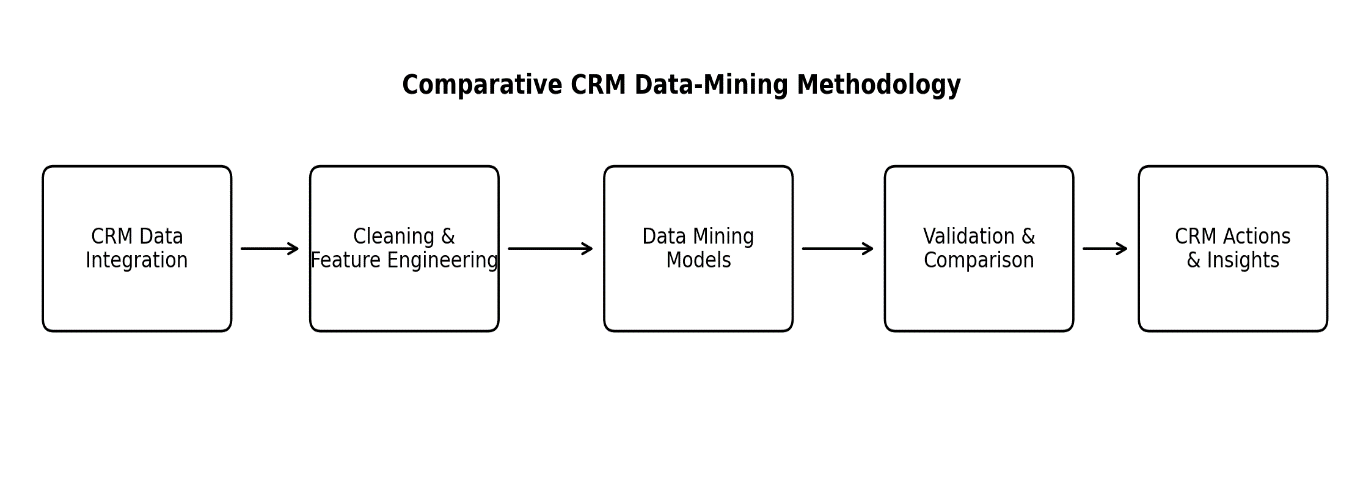
Customer relationship management (CRM) depends on the ability to convert large volumes of customer, transaction, service, and interaction data into decisions that improve acquisition, retention, segmentation, and customer value. This methodology paper presents a comparative framework for evaluating widely used data mining techniques in CRM. The study considers descriptive techniques such as clustering and association-rule mining together with predictive techniques including logistic regression, decision trees, random forests, k-nearest neighbors, support vector machines, and neural-network-oriented approaches reported in prior literature. The proposed methodology integrates CRM data preparation, feature engineering, stratified model validation, and multi-metric comparison using accuracy, precision, recall, F1-score, and area under the ROC curve (AUC). A fixed-seed synthetic CRM benchmark is used only to demonstrate the evaluation procedure without claiming access to proprietary customer records. The benchmark shows why algorithm selection must reflect the CRM objective: high overall accuracy can conceal weak churn recall, while interpretable statistical models may remain competitive after appropriate data preparation. The paper concludes that CRM analytics should combine predictive performance, interpretability, class-imbalance handling, scalability, and managerial actionability rather than selecting a technique by a single accuracy value.