QoSCollab: A Token-Governed SaaS Architecture for Real-Time QoS Testing, ML-Based Efficiency Prediction, and Service Recommendation
DOI:
https://doi.org/10.65521/ijacte.v15i1.2946Keywords:
Abstract
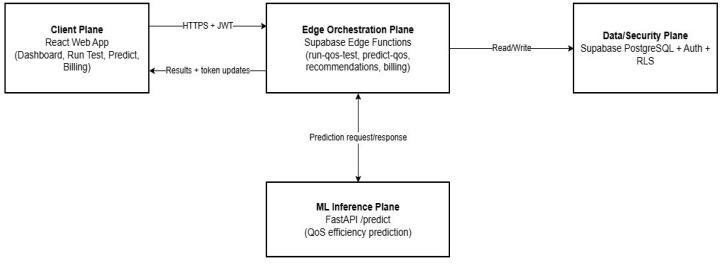
Quality of Service (QoS) management for web services is usually over the place. It is spread across testing tools, analytics dashboards, predictive models, and billing systems. This paper is about QoS Collab, an integrated Software-as-a-Service (SaaS) platform that unifies real-time QoS testing, makes predictions based on machine-learning, service recommendation and comparison, and token-governed execution within a single deployable architecture. The system is implemented using a React/TypeScript frontend, a Supabase backend comprising PostgreSQL, row-level security (RLS), edge functions, and real-time channels, and a FastAPI model-serving microservice. QoS testing checks latency and uptime and throughput and failure-sensitive refund logic. Experimental evaluation demonstrates that a baseline Linear Regression pipeline achieves a holdout R² of 0.5350 (MAE = 1.4590, RMSE = 1.8122), whereas an optimized ensemble pipeline yields R² = 0.6804 (MAE = 1.0706, RMSE = 1.3324), representing a 27.2% improvement in explained variance and a 26.6% reduction in MAE. Platform-level workflows confirm the practical feasibility of combining observability, predictive analytics, and consumption-based billing governance in a unified operational design. The study also found some things to consider when making production grade Machine Learning-driven Quality of Service systems.