Comparative Analysis of Metaheuristic Optimization Algorithms for Engineering Applications
DOI:
https://doi.org/10.65521/ijacte.v9i1.4124Keywords:
Abstract
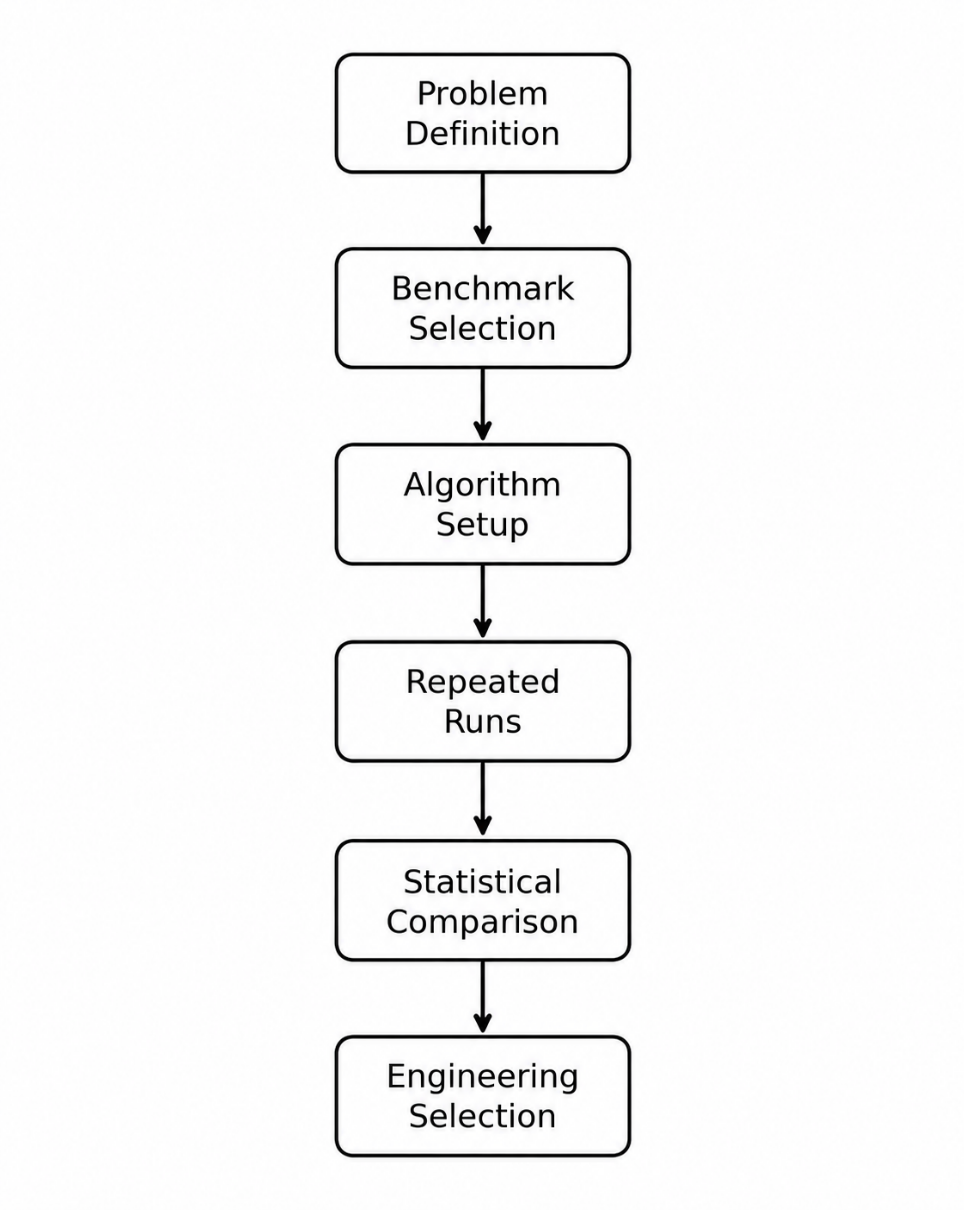
Metaheuristic optimization has become a practical alternative to gradient-based techniques for engineering problems that are nonlinear, multimodal, discontinuous, or expensive to evaluate. This methodology paper presents a reproducible comparative framework for five widely used algorithms: Genetic Algorithm (GA), Particle Swarm Optimization (PSO), Differential Evolution (DE), Grey Wolf Optimizer (GWO), and Whale Optimization Algorithm (WOA). The study controls population size, iteration budget, problem dimension, search bounds, and independent random seeds to permit a fair comparison. Four standard continuous functions—Sphere, Rastrigin, Ackley, and Rosenbrock—represent smooth, multimodal, and narrow-valley landscapes commonly used as surrogates for engineering design difficulty. Each method is executed eight times with 30 search agents and 150 iterations in 20 dimensions. Performance is evaluated using mean final objective value, standard deviation, robustness, convergence behavior, and implementation complexity. The computed results show that no algorithmic metaphor guarantees universal superiority; however, under the stated settings WOA and GWO provide the strongest final accuracy, whereas GA offers comparatively stable behavior with a straightforward operator structure. The framework is intended for preliminary optimizer screening before deployment to constrained structural, mechanical, electrical, and manufacturing design problems.