An Efficient Resource Allocation Model for Virtualized Cloud Computing Platforms
DOI:
https://doi.org/10.65521/ijacte.v10i1.4120Keywords:
Abstract
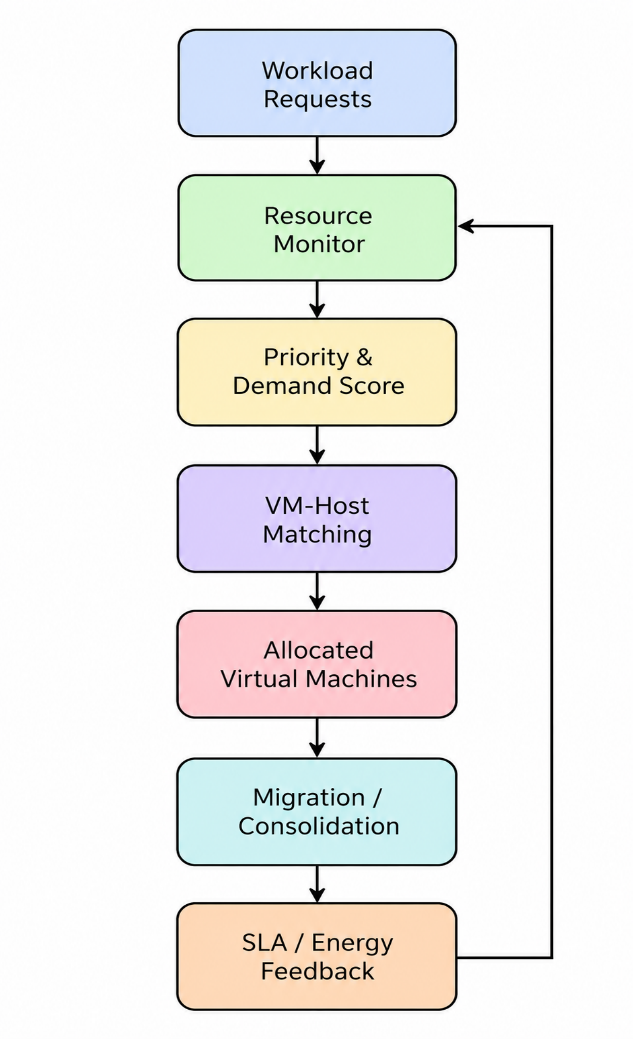
Virtualized cloud platforms must continuously map heterogeneous application demands to finite CPU, memory, bandwidth, and storage resources while maintaining service-level agreements (SLAs) and limiting energy consumption. This methodology paper proposes an adaptive multi-resource allocation model that combines demand scoring, utilization-aware virtual-machine (VM) placement, overload detection, and selective VM consolidation. The model estimates a normalized demand vector for each request, ranks requests by urgency and SLA sensitivity, and assigns them to physical hosts through a weighted fitness function that penalizes capacity imbalance, projected energy use, and SLA risk. A feedback stage triggers migration only when the expected benefit exceeds a migration-cost threshold. The evaluation design uses a CloudSim-style virtual data-center scenario and compares the proposed method with a utilization-only baseline. Illustrative simulation results show higher average CPU utilization (82% versus 68%), improved SLA satisfaction (97% versus 91%), an 18% reduction in energy consumption, and a 23% reduction in mean response time. These results indicate that joint consideration of multiple resources and migration cost can improve consolidation without creating excessive SLA violations. The proposed framework is reproducible, implementation-oriented, and suitable for extension with forecasting or reinforcement learning.