Comparative Study of Metaheuristic Algorithms for Big Data Optimization Problems
DOI:
https://doi.org/10.65521/ijacte.v10i1.4118Keywords:
Abstract
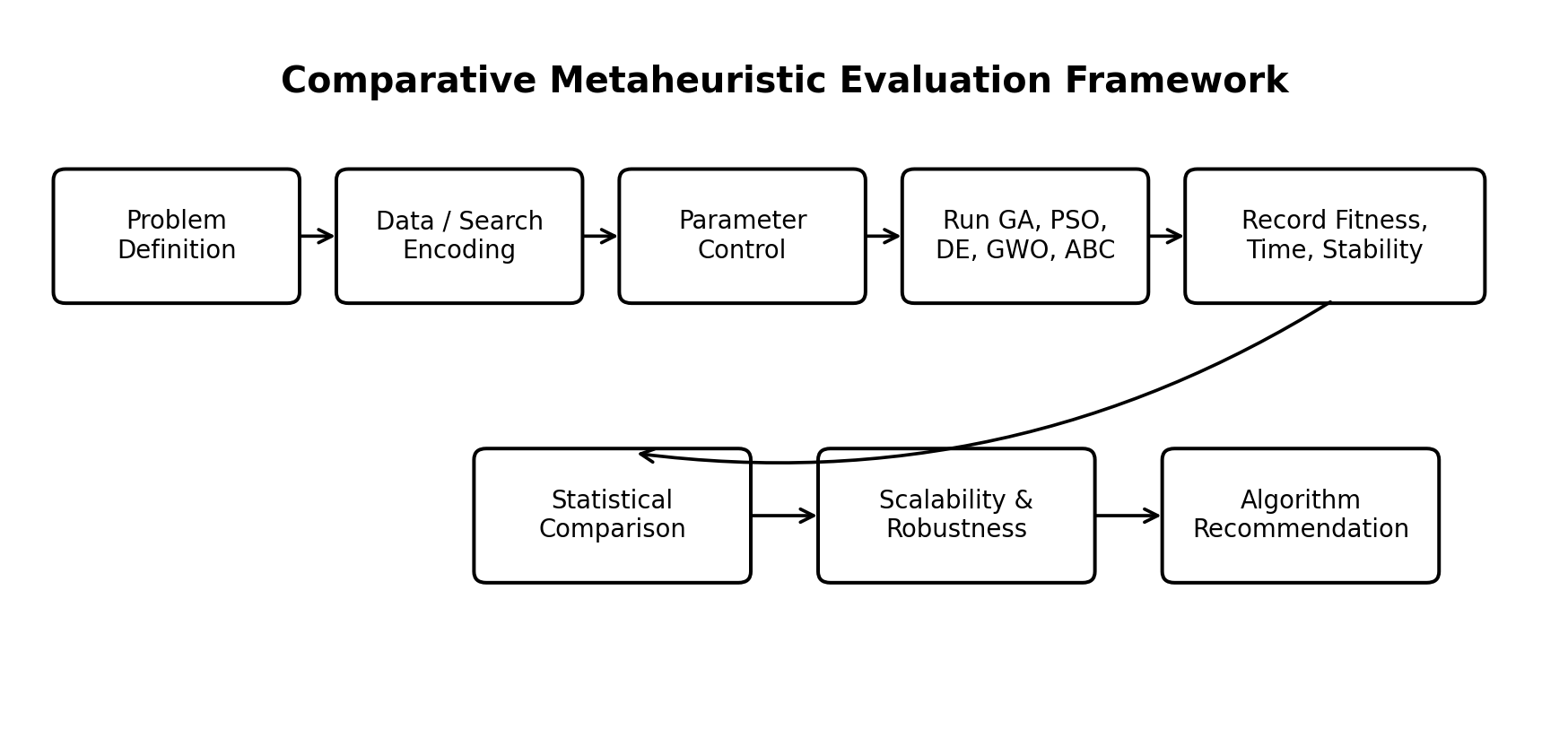
Big data optimization problems are characterized by high dimensionality, nonlinear search spaces, large numbers of candidate decisions, and computational costs that can make exact optimization impractical. This study develops and evaluates a comparative methodology for five representative metaheuristic algorithms: Genetic Algorithm (GA), Particle Swarm Optimization (PSO), Differential Evolution (DE), Grey Wolf Optimizer (GWO), and Artificial Bee Colony (ABC). The framework combines literature-based algorithm selection with a controlled benchmark experiment on 50-dimensional Sphere, Rastrigin, and Ackley functions. Each algorithm is evaluated under a common population budget and iteration limit using solution quality, stability, convergence behavior, and computational time. The benchmark results show that performance is problem dependent; in the implemented setting GWO achieved the lowest mean objective value on all three test functions, while PSO required the least computational time. GA provided a comparatively strong compromise between quality and stability on multimodal functions. The results support the no-free-lunch view that algorithm selection should be matched to problem structure, resource constraints, and scalability requirements rather than based on a universal ranking. For practical big-data environments, the study recommends parallel evaluation, adaptive parameter control, and hybridization as the most promising routes for improving scalability and robustness.