IoT and Wireless Sensor Network-Based Three-Tier Architecture for Continuous Cardiac Monitoring: A Comprehensive Review
DOI:
https://doi.org/10.65521/ijacte.v12i2.3826Keywords:
Abstract
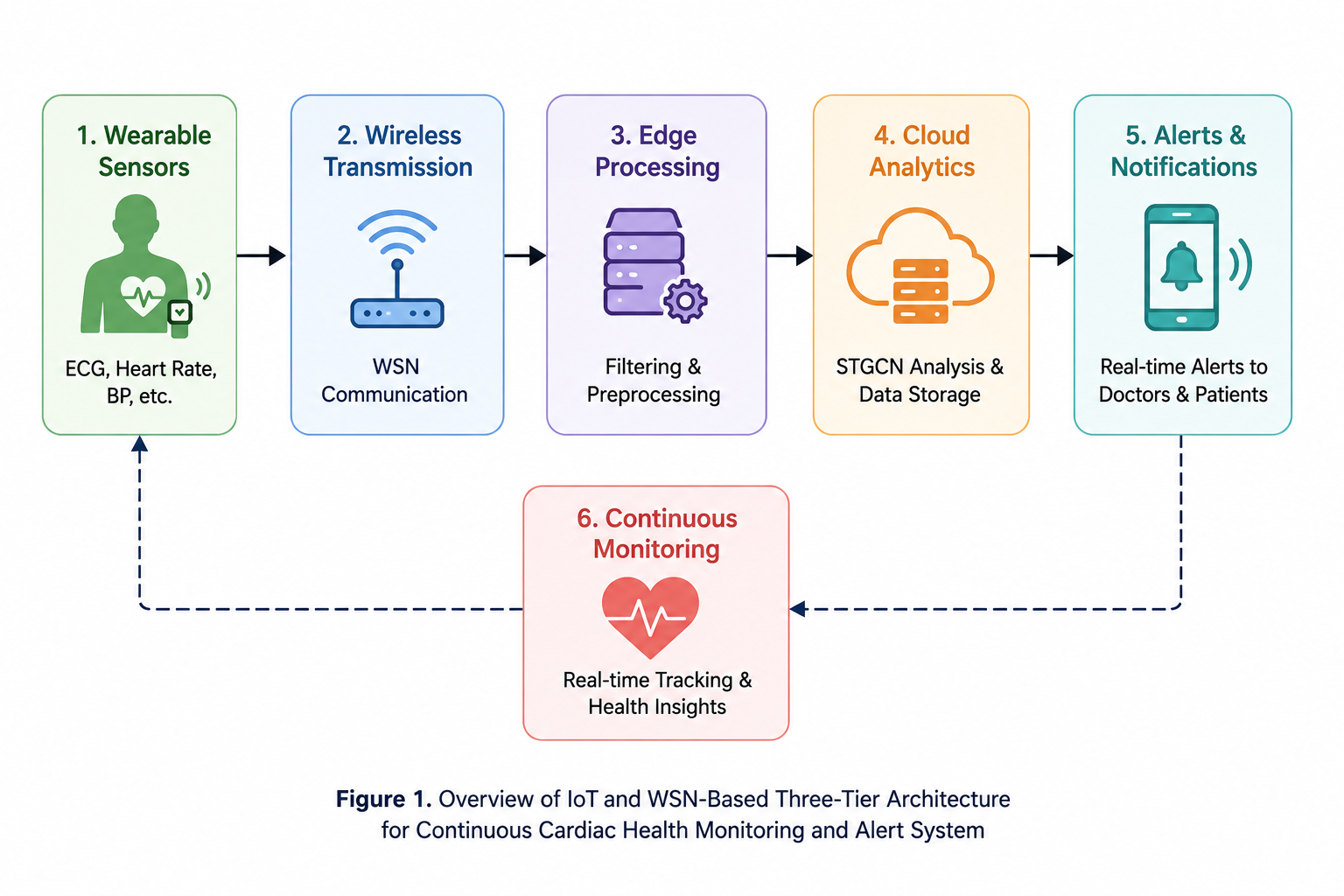
The rapid advancement of Internet of Things (IoT) and wireless sensor networks (WSNs) has significantly transformed modern healthcare systems, particularly in continuous cardiac health monitoring. Cardiovascular diseases remain one of the leading causes of mortality worldwide, necessitating real-time, accurate, and energy-efficient monitoring solutions. Traditional monitoring systems are often limited by delayed diagnosis, lack of scalability, and inefficient data processing. To address these challenges, IoT-enabled three-tier architectures integrated with advanced deep learning models have emerged as a promising solution. This study presents a comprehensive review of IoT and WSN-based three-tier architectures for continuous cardiac health monitoring, emphasizing the role of Spatio-Temporal Graph Convolutional Networks (STGCNs). These models effectively capture spatial and temporal dependencies in physiological signals such as ECG, enabling improved prediction and early detection of cardiac abnormalities. Recent studies demonstrate that STGCNs provide high accuracy while maintaining computational efficiency, making them suitable for real-time healthcare applications. Furthermore, advanced graph-based models such as PhysGCN leverage non-Euclidean representations to enhance feature learning and robustness in physiological signal analysis. The integration of IoT, edge computing, and STGCN-based models enables efficient data acquisition, processing, and decision-making across multiple system layers. This review highlights recent advancements, identifies key challenges such as energy constraints and data security, and discusses future directions for developing intelligent and scalable cardiac monitoring systems.